Can AI help you start a blog if you have never published a website before? Yes—as a planning, research, drafting, and editing assistant. But it cannot give you firsthand experience, verify every fact, earn an audience automatically, or guarantee income. The practical goal for your first month is smaller: launch one genuinely useful blog with a clear reader, a manageable publishing system, and a way to learn from feedback.
This guide uses a realistic example: an English-language blog helping apartment renters solve everyday home problems. It gives you a complete four-week plan, five copy-ready AI prompts, a worked example, a quality-control checklist, and a decision framework for what to publish. You can apply the same process to hobbies, travel, career skills, or other subjects you know.
Start with the reader, not the AI tool
A weak blog idea is “everything about lifestyle.” A stronger promise is “simple, renter-friendly ways to keep a small apartment organized without permanent changes.” The second gives a reader a reason to visit and gives you a standard for rejecting unrelated topics.
- Audience: Who is the specific reader? Example: people renting small apartments in the United States.
- Problem: What practical difficulty will they bring to a search engine? Example: how to remove everyday odors without damaging a rental.
- Experience: What can you demonstrate, research carefully, test, or document?
- Promise: What will a person accomplish after reading one page?
- Boundary: Which topics are outside your expertise or require a professional?
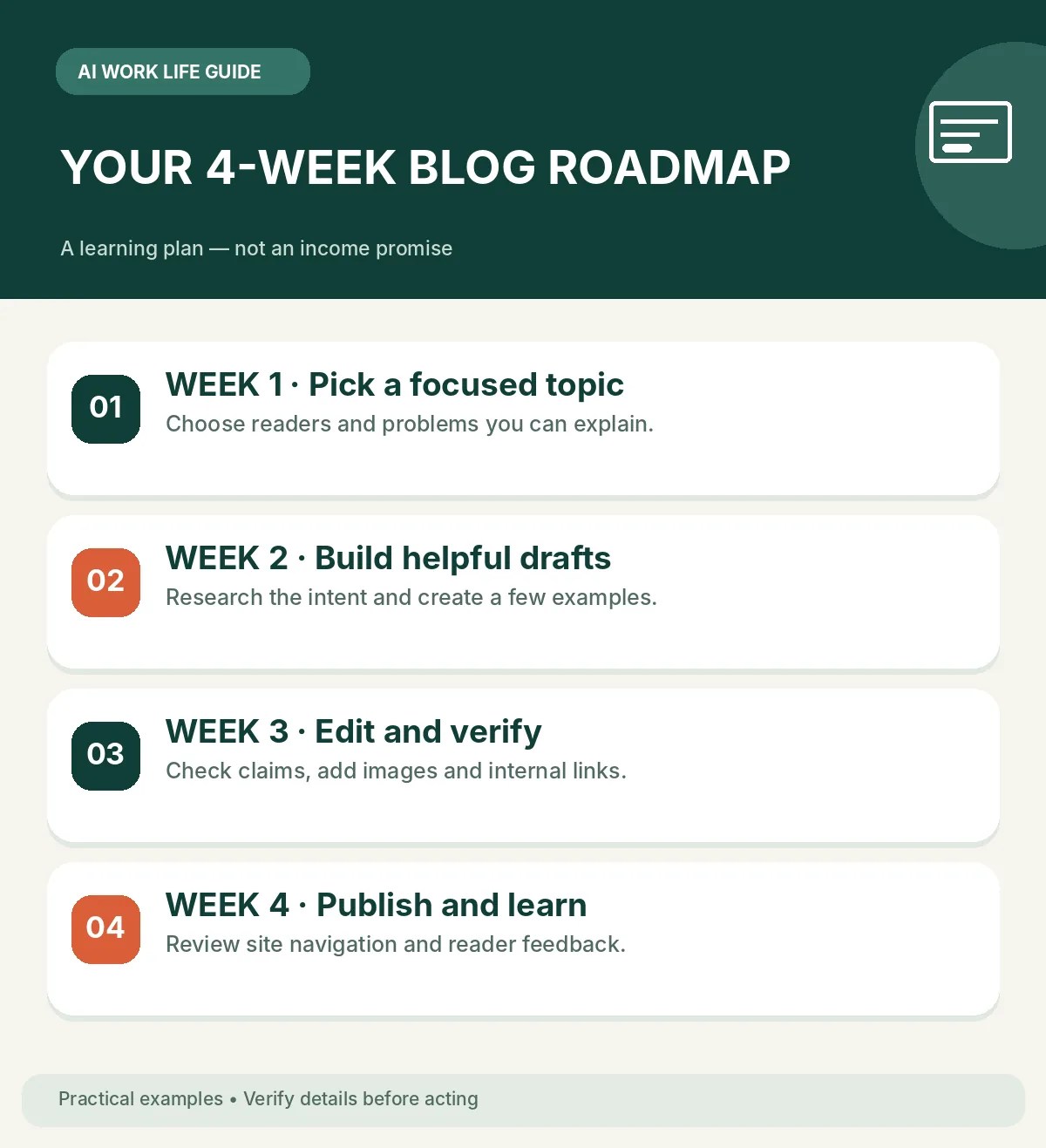
A four-week AI-assisted blog launch plan
| Week | One measurable outcome | Key actions | Evidence of completion |
|---|---|---|---|
| 1 — Define | One clear audience and topic promise | Write reader profile; select 3–5 initial questions; choose a realistic publishing cadence | A one-page editorial brief and topic shortlist |
| 2 — Build | A navigable, trustworthy website | Set up platform; create About, Contact, and privacy information appropriate to the site; test mobile navigation | Pages load, links work, site identity is clear |
| 3 — Publish | Two or three thoroughly checked articles | Research source material; add original examples and useful images; edit for clarity | Real pages with useful answers and working links |
| 4 — Improve | A repeatable publishing and measurement routine | Fix page issues; review search indexing tools; collect reader questions; plan next pieces | Documented quality checks and next four article ideas |
These are suggested milestones, not prerequisites for search visibility or advertising approval. Publishing more articles quickly is not necessarily better than improving articles that genuinely answer a reader’s question.
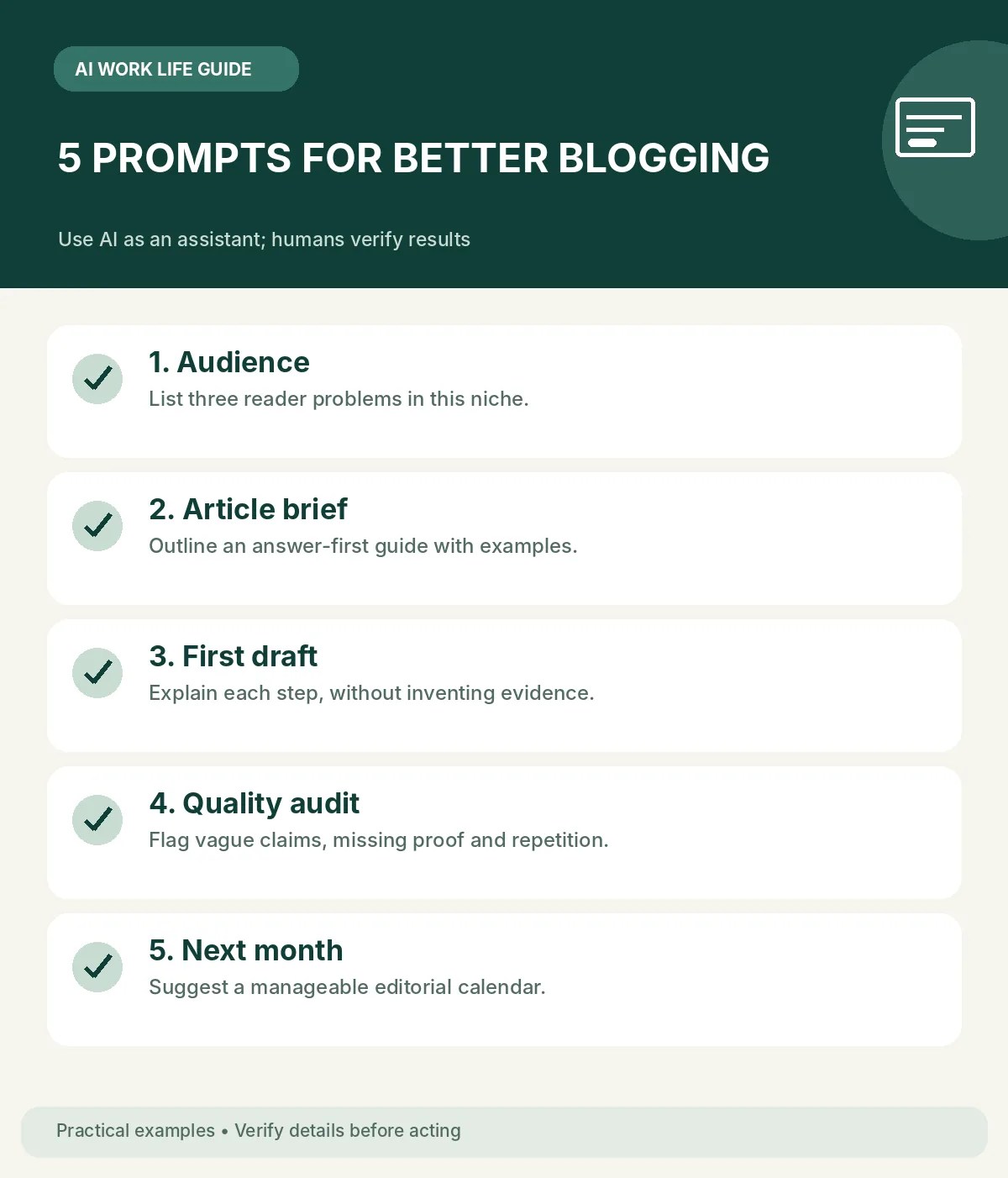
Prompt 1: Find a focused topic you can genuinely support
I want to create a helpful blog, not a content farm.
Audience: [Who I want to serve]
My real knowledge or experience: [What I know]
Topics I can verify or demonstrate: [List]
Time available each week: [Hours]
Topics I will avoid: [Areas outside my expertise]

Propose 5 narrowly defined blog concepts. For each, give:
- The specific reader problem
- 3 example article questions
- What firsthand proof or source verification I would need
- The main difficulty of sustaining quality
- A one-sentence site promise
Do not claim search volume, ranking difficulty, or income
without verifiable data.
Prompt 2: Turn a topic into an article brief, not a generic essay
Consider the apartment-renter example. Instead of asking for “an SEO article about apartment odors,” make the assistant identify the real-world question and what needs checking. AI suggestions must be verified against relevant manufacturer instructions, lease restrictions, and reliable safety guidance before publication.
You are an editorial research assistant for a reader-first blog.
Reader: [Audience]
Reader question: [Exact problem]
What I have personally tried: [Notes, or 'none']
Reliable source material I have: [Links, or 'not yet']

Create an article brief with:
1. A clear answer to the reader's question
2. What the reader needs to know first
3. Steps that can be explained safely and accurately
4. Claims needing authoritative sources
5. A useful original example, test, or photo I could add
6. Common mistakes and when professional help is needed
7. A conclusion with one practical next action
Flag uncertainty. Do not invent experiences, citations,
product testing, or results.
Prompt 3: Produce a first draft with transparent limitations
Use the verified article brief below to write a practical draft.
[Paste the brief and verified notes]

Requirements:
- Answer the primary question in the opening paragraph.
- Use descriptive headings, not exaggerated promises.
- Explain steps in plain American English.
- Mark any unsupported factual claim [VERIFY].
- Clearly distinguish my experience from general guidance.
- Include a useful example, checklist, or comparison.
- Do not fabricate quotes, statistics, product use, or links.
- Do not suggest that AI-generated text has been tested.
- End with a short safety/limitations note where relevant.
What makes an article helpful rather than merely long?
For the sample article “How to Organize a Tiny Rental Kitchen Without Drilling,” a reader benefits more from an illustrated layout, cabinet measurements, weight limitations, lease-friendly constraints, and a removal checklist than from 2,000 words of generic advice. Long articles are justified only when the reader’s problem requires depth.
- Clear outcome: The opening says what a reader can do after following the guide.
- Original contribution: Actual examples, annotated photos, tested steps, comparison criteria, or honest observations.
- Verifiable claims: Sources match the specific claim, and links work.
- Useful presentation: Short sections, meaningful images, accessible alt text, and tables only where they help.
- Credible authorship: The site explains who creates and reviews its content.
- No invented authority: Avoid fictitious experts, false hands-on testing, or blanket guarantees.
Prompt 4: Audit the article before publishing
Act as a critical editor. Do not flatter the draft.
[Paste article draft]

Create a table with columns:
Issue | Exact passage | Why it matters | Suggested fix.
Check for:
- Unanswered reader questions
- Factual claims without an appropriate source
- Invented personal experience or unsupported numbers
- Repetition and filler
- Safety, privacy, or financial overstatements
- Confusing steps and missing prerequisites
- Headlines that overpromise
- Opportunities for a useful original example
Then write a 100-word summary of what still requires
human verification before publication.
Prompt 5: Build a sustainable next-month editorial calendar
I have [number] hours per week for my blog.
My audience is [audience].
My existing posts cover [topics].
Questions from readers or my own experience: [notes].

Suggest 4 complementary articles for next month.
For each provide:
- One specific reader question
- Why it is distinct from my existing posts
- Research and firsthand materials I will need
- A realistic effort estimate, labeled as an estimate
- A simple internal-link opportunity
- A 'publish only when' quality condition
Do not invent traffic forecasts or guaranteed earnings.
A realistic example: choosing the first three articles
Suppose your site focuses on rental-friendly small-space living. Your opening library could cover three complementary needs rather than repeating nearly identical keywords.
| Article | Unique user need | Original value to add |
|---|---|---|
| How to Measure a Small Closet Before Buying Storage | Avoid a poor fit | A printable measurement checklist and labeled example |
| Rental-Friendly Kitchen Storage: What to Check First | Avoid damage and clutter | Lease restrictions, surface compatibility, and a sample layout |
| An Apartment Move-In Inspection Checklist | Document existing issues | Room-by-room checklist and sample non-sensitive photo labels |
Each article earns its place by solving a distinct problem. An AI assistant can outline them, but the publisher must verify advice, provide authentic examples, and keep the site accurate.
Set up a simple publishing workflow
- Capture: Record a real reader question and the answer you intend to provide.
- Research: Collect firsthand notes and credible, relevant primary sources.
- Draft: Use AI to organize the explanation, not manufacture expertise.
- Verify: Check statements, screenshots, calculations, quotations, and outbound links.
- Illustrate: Add useful photos or diagrams; label illustrative AI-generated scenes when that distinction matters.
- Publish: Test the page on a phone, check readability and navigation, and make the author identifiable.
- Improve: Correct errors, update changing details, and use real questions to guide future articles.
What about Google Search and AdSense?
A useful blog can be built with AI assistance, but Google visibility and advertising approval are separate processes. No prompt, article count, or publishing schedule guarantees either outcome. Google Search Central emphasizes helpful, reliable, people-first content and provides guidance on the appropriate use of generative AI. If you later apply for advertising, review the current AdSense program policies and your site’s eligibility directly instead of relying on generic approval checklists.
- Google Search Central: Creating helpful, reliable, people-first content.
- Google Search Central: Guidance on using generative AI content.
- Google AdSense: Program policies.
How much time or money should you expect?
A small personal blog can start with modest software costs, but actual prices vary by provider, domain, theme, storage, and subscription level. Research, visual assets, content testing, accessibility, maintenance, and corrections all require time. The four-week schedule here is an organizational example, not evidence that a profitable blog can be launched in four weeks. Begin with a workload you can maintain and compare actual results over time.
Frequently asked questions
Can I publish an AI-written blog post without editing it?
You may be able to paste a draft into a publishing tool, but doing so without checking its accuracy, usefulness, originality, and rights is a poor editorial practice. Review every substantive claim and make sure the page offers something genuinely useful.
Should my first blog cover many different topics?
A focused reader promise is usually easier to maintain consistently. Expand when you can show that the new topic serves the same audience and you have credible material to contribute.
Does using AI automatically disqualify a site from search or advertising?
The use of AI by itself does not determine whether a page is helpful. Quality, intent, accuracy, policy compliance, and the actual site experience matter. Check the latest official guidance for the platforms you use.
Is four weeks enough to make money?
There is no reliable income timeline. The plan is designed to help you build a useful website and learn a repeatable publishing process, not predict earnings.
The first action to take today
Write one sentence that names your reader and the problem your site solves. Then list five real questions that reader would ask. Before drafting anything, circle the question you can answer most accurately with evidence or personal experience. That is a much stronger starting point than asking AI to generate dozens of generic posts.
Editorial disclosure: AI can assist with planning and drafting; all examples in this guide are illustrative and are not claims of firsthand product testing or guaranteed results. External policies and platform features can change.
Related: Turn scattered project notes into an action plan with AI and Plan a realistic workday with AI.
Leave a comment