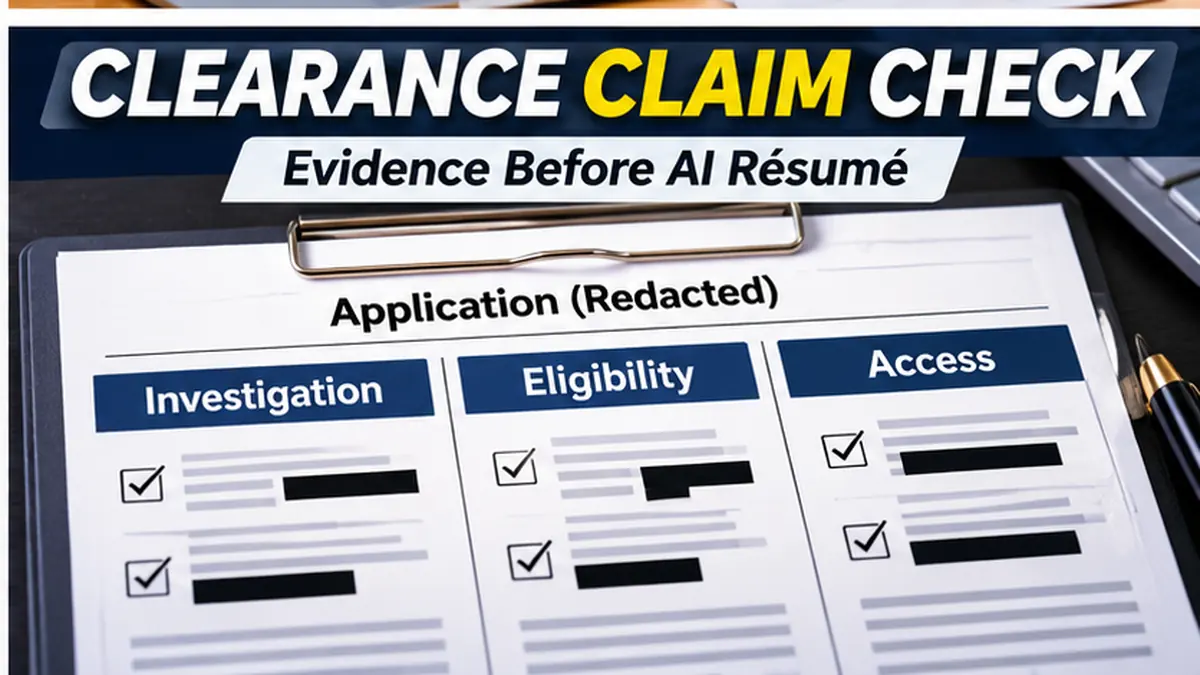
Quick answer: Never let an AI résumé turn “background investigation started,” “clearance eligible,” “held access on a former project,” or “can obtain a clearance” into the unqualified sentence “I hold an active security clearance.” Those statements describe different facts. Before applying to a U.S. role requiring vetting, verify the precise current status through the authorized security office or sponsoring employer and use only wording that the underlying records support. Do not upload classified information, security forms or personally identifying vetting records to an AI tool.
Scope and evidence: U.S. federal and federal-contractor job applicants. DCSA’s investigation and facility-security guidance reviewed November 12, 2026. This is an editorial terminology and evidence audit, not a clearance-status lookup, employer screening, background investigation or legal determination. A security office—not this article—must confirm the status relevant to a particular position.
Reproducible redacted résumé editing example
Hypothetical sample, not an actual applicant: An AI résumé generator writes, “Active Secret clearance; approved for classified access.” The only evidence available to the applicant is an email acknowledging that an investigation questionnaire was submitted. Evidence check: the email establishes receipt of a questionnaire, not a favorable eligibility decision or present authorized access. Remove both clearance assertions rather than replacing them with “eligible.” If the role asks about clearance, answer the employer’s exact question truthfully and confirm status privately with the sponsoring security office. Re-run the AI draft check: search for active, cleared, eligible, access, interim and compare every occurrence against approved evidence. Do not put a questionnaire, identifying vetting number or classified detail in a public résumé or an AI prompt.
Four words with materially different meanings
| Candidate draft says | What the underlying event might actually be | Safe evidence gate | Stop if |
|---|---|---|---|
| Security clearance granted | A completed favorable security eligibility decision | Security office confirms what decision exists and whether it is current | Only an application or pending investigation is documented |
| Investigation completed | Background investigation finished | Check whether a separate adjudication/eligibility decision was made | The record shows completion but no eligibility decision |
| Currently has classified access | Person is authorized and has a current need to know | Employer/security office can verify applicable access status | Only historic access or a favorable eligibility record is known |
| Eligible for a clearance | A future employer could consider sponsoring an applicant | Use precise official or employer language without promising approval | AI inferred eligibility solely from citizenship or job history |
DCSA explains that a sponsoring organization evaluates investigation results and makes the suitability or security decision. An investigation, eligibility outcome and actual access are related but not identical steps. The DCSA’s own frequently asked questions also caution against simplistic “expiration” interpretations: a status still must be validated for the position and current vetting conditions.
A reproducible claim audit: no sensitive data required
Create a private, offline four-field worksheet: draft wording, confirmed document category, authorized verifier and revised claim. A hypothetical example: an AI draft says “Active Secret clearance.” The applicant only has a dated investigation scheduling email. That email supports an investigation was scheduled; it does not support a grant or current classified access. Remove the clearance assertion until an authorized security official confirms appropriate wording.
| Illustrative evidence | Could support | Cannot independently support |
|---|---|---|
| Invitation to complete a security questionnaire | An administrative vetting step was initiated | Clearance granted or active access |
| Investigation status correspondence | A particular process milestone | Final favorable decision unless stated and verified |
| Dated previous employer letter | A historical job or clearance-related claim if issuer can substantiate it | Present access at a new employer |
| Verification from authorized security office | Specific current status confirmed for permitted disclosure | Permission to disclose classified details or unrelated records |
Six-step editing procedure for an AI-assisted résumé
- Extract every security-related phrase. Search for ‘active’, ‘current’, ‘cleared’, ‘eligible’, ‘investigated’, ‘interim’ and similar words.
- Identify the exact action or decision. Was it an application, investigation, eligibility decision or granted access? Never collapse categories.
- Verify privately. Ask the employing or sponsoring security office for status and approved public wording; do not self-certify based on recollection.
- Rewrite conservatively. If status cannot be verified, omit the clearance claim rather than invent an eligibility label.
- Remove sensitive details. Do not disclose names of classified programs, protected project identifiers, forms, security answers or other restricted information.
- Recheck the final file. Inspect tracked changes, comments and metadata before sending an otherwise accurate résumé.
What if the job announcement requires a clearance?
Eligibility for employment and access to classified information can be decided through different processes; employer requirements vary. An applicant who does not hold a verifiable clearance should answer the actual application question accurately and may need employer sponsorship or a separate screening. Do not claim that a résumé phrase alone causes an agency to accept or reject an application; the purpose here is preventing false statements.
Publicly documented case: In a 2016 sentencing release, the U.S. Department of Justice reported that Wayne Shelby Simmons falsely claimed prior CIA employment and a previous top-secret clearance while seeking government positions that required security clearances. After pleading guilty, he was sentenced to 33 months in prison. This is a documented case of deliberate misrepresentation, not evidence that an ordinary résumé mistake is fraud. Read the DOJ case summary.
Authoritative sources and the limits of this audit
The DCSA investigations and clearance process describes investigation, sponsoring agency review and security decisions. The DCSA facility security FAQ explains ongoing vetting and the risks of oversimplifying currency. Its records request page describes avenues to request one’s own adjudication records. This site’s claim-audit table is an editorial interpretation for truthful wording, not an official security certification.
Next action: Have an authorized security office verify any current claim. Then review the Keep, Qualify, Remove or Hold claim worksheet and hidden-comment and PDF metadata guide. Request a correction.