
FAMILY EMERGENCY PLAN
Contacts · Local alerts · Safe meeting places
American household preparedness · Begin before an emergency. AI can help draft a household planning worksheet, but official local alerts and emergency instructions always take priority. The people and scenarios in this guide are illustrative.
A useful family emergency plan should answer simple questions even when your internet connection, power, or everyday routine is disrupted: How will everyone receive warnings? Where should each person go? Who checks on children, older adults, or pets? Where is a paper copy of the contact plan? AI can help you build a blank worksheet, but it cannot know your local hazards or make safety decisions for you.
The U.S. government’s Ready.gov Make a Plan materials emphasize talking with household members, learning local alerts, planning communication and evacuation, tailoring the plan to specific needs, then practicing. Use that official framework first. Our AI workflow follows it rather than improvising disaster instructions.
Jump to: Safety first · Household questions · AI prompt · Fictional example · Supply review · Practice · Final checklist.
1. Do not ask a chatbot what to do during an active emergency
If an emergency or evacuation order is active, follow instructions from emergency management officials and the public safety authorities responsible for your location. In the United States, call 911 for an immediate emergency when available. Use the sources your area identifies for warnings and public shelter information. Do not wait for a chatbot to confirm a warning, infer a safe evacuation route, or decide whether floodwater, smoke, an electrical hazard, or a damaged building is safe.
Ready.gov, the FEMA App, and local public agencies provide resources to help residents prepare and identify available alerts. Information can change quickly. Save official local websites, radio channels, and alert methods in advance, and build a plan that works when your phone battery or mobile data is limited.
2. Gather the five facts your household can verify
- Local warning channels. Write down how you receive community emergency notifications, weather alerts, school notices, and public evacuation orders; check the responsible official sources.
- Communication. Identify an out-of-area contact, one or more approved ways to reach them, and a backup if texting or mobile networks fail.
- Meeting points. Agree on a nearby meeting place and a destination outside your neighborhood when appropriate, subject to official instructions and accessibility.
- Evacuation and shelter options. Discuss how people with different mobility or language needs and household pets can leave or shelter safely. Verify any destination and transport arrangement.
- Supplies and records. Identify existing medications, assistive devices, infant or pet needs, paper contact information, and household supply locations without uploading private details to a consumer AI service.
Do not put your home address, children’s schedules, live phone numbers, diagnoses, prescriptions, passport scans, keys, emergency access codes, or evacuation destinations into an unapproved AI prompt. If the assistant only needs a structure, use [HOME], [CONTACT A], [MEETING POINT], and [SPECIAL NEED] placeholders. Our AI privacy guide explains a safer way to prepare inputs.
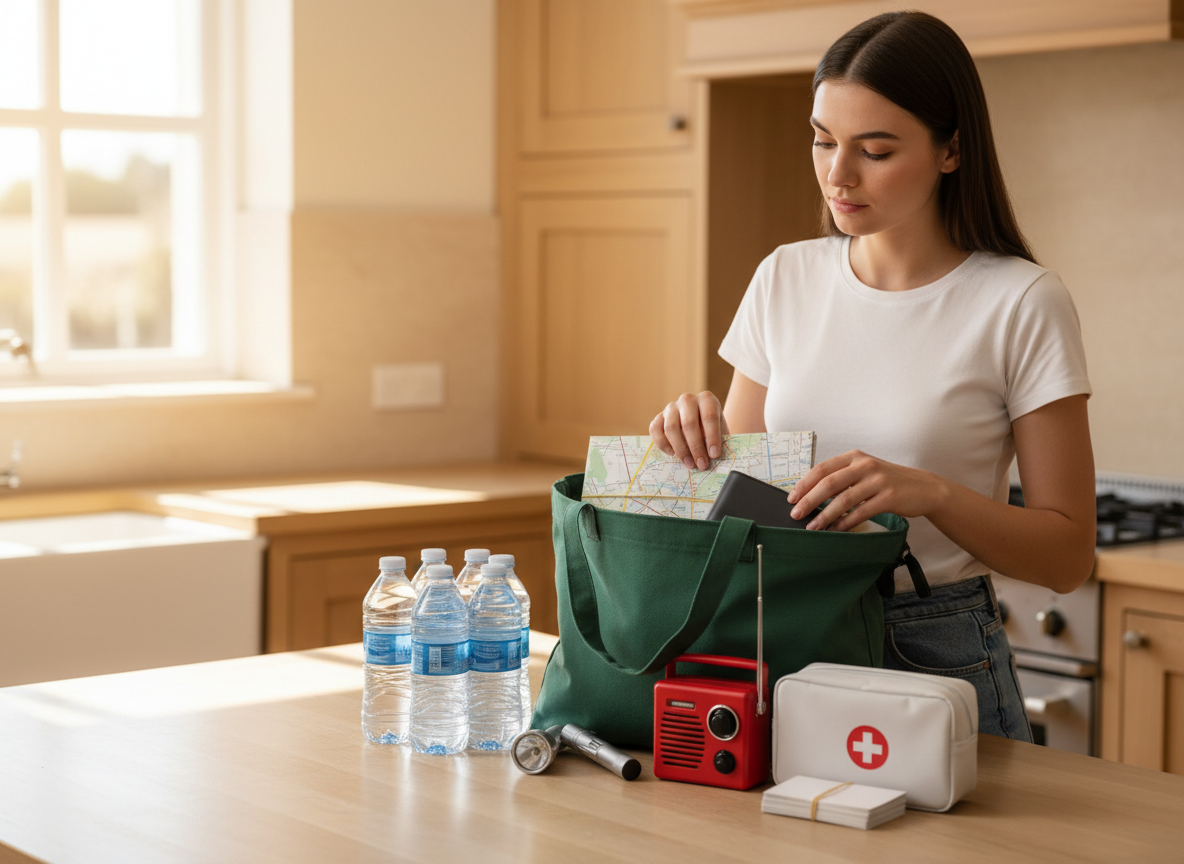
CHECK YOUR ACTUAL NEEDS
Supplies · Contacts · Backup power
Illustrative AI-generated image. The pictured items are examples, not a complete emergency kit or a personalized safety recommendation.
3. Copy this AI prompt to draft a blank communication plan
This prompt deliberately avoids real identifying details. After you get a structure, fill in actual contacts and locations outside the AI tool in a private printed or protected document. Ask every household member to check it, and confirm local response requirements with your public agencies.
Create an editable U.S. household emergency PLAN TEMPLATE.
Do not assume a particular disaster or give live evacuation advice.
Use ONLY the following non-sensitive placeholders:
Household roles: [ADULT A], [ADULT B], [CHILD ROLE].
Special planning considerations: [generic role only].
Region or hazards: [leave as TO VERIFY WITH LOCAL OFFICIALS].

Include fields for:
1. Official local warning sources and backup channels.
2. An out-of-area contact and multiple ways to communicate.
3. Two possible meeting-place fields [TO BE CONFIRMED].
4. Evacuation/shelter steps [FOLLOW LOCAL INSTRUCTIONS].
5. Roles for children, pets, accessibility, and equipment.
6. Supplies, backup power, and a paper copy location.
7. Last reviewed, drill date, and unresolved questions.

Do not invent safe routes, shelter openings, phone numbers,
water amounts, medicine instructions, or emergency contacts.
Mark every missing item [VERIFY OFFLINE].
Check that the output contains blank fields rather than fabricated names and local shelter addresses. An impressive-looking worksheet with a fake contact number can be dangerous. If AI fills in details you did not supply, delete them and replace them with a verification task.
4. Worked example: a fictional household preparing ahead of time
Imagine a household with two adults, one school-age child, and a pet. No real addresses, contacts, or health records are used. One adult commutes far away on weekdays and the child attends school. The question is not ‘Which road is safe?’ but ‘What do we need to confirm together while there is time?’
| Planning field | Fictional entry | Required verification |
|---|---|---|
| Warnings | [LOCAL ALERT SERVICE] | Local agency and phone setup |
| Out-of-area contact | [CONTACT PERSON] | Consent and current details |
| Near meeting point | [NEARBY LOCATION] | Accessibility and conditions |
| Alternate destination | [BACKUP LOCATION] | Directions and official advice |
| Child pickup | [AUTHORIZED ADULT] | School’s actual policy |
| Pet supplies | [PET KIT LOCATION] | Food, transport, identification |
| Plan review | [DATE] | Household practice and changes |
The household then contacts the school to confirm authorized pickup arrangements and reviews local emergency alerts. They decide where paper contact cards belong, check whether the planned meeting sites make sense for mobility needs, and identify a backup if someone cannot reach the primary contact. None of these details can be safely certified by an AI text generator.
5. Review supplies using official guidance, not a generated shopping list
FEMA’s Build a Kit information is a practical starting point for evaluating water, food, lighting, radio information, charging, first aid, and hygiene supplies. Household needs differ with infants, children, disabilities, specific medical equipment, pets, climate, and local risks. Ready.gov has a public supply checklist to help you review common items.
Have AI sort a list you already made into ‘on hand,’ ‘need to check,’ and ‘missing,’ but do not let it guess medication amounts or expiration dates, substitute unverified food and water safety instructions, or tell you an item is safe without reading its actual label and official instructions. Check batteries and supplies personally and label recheck dates.
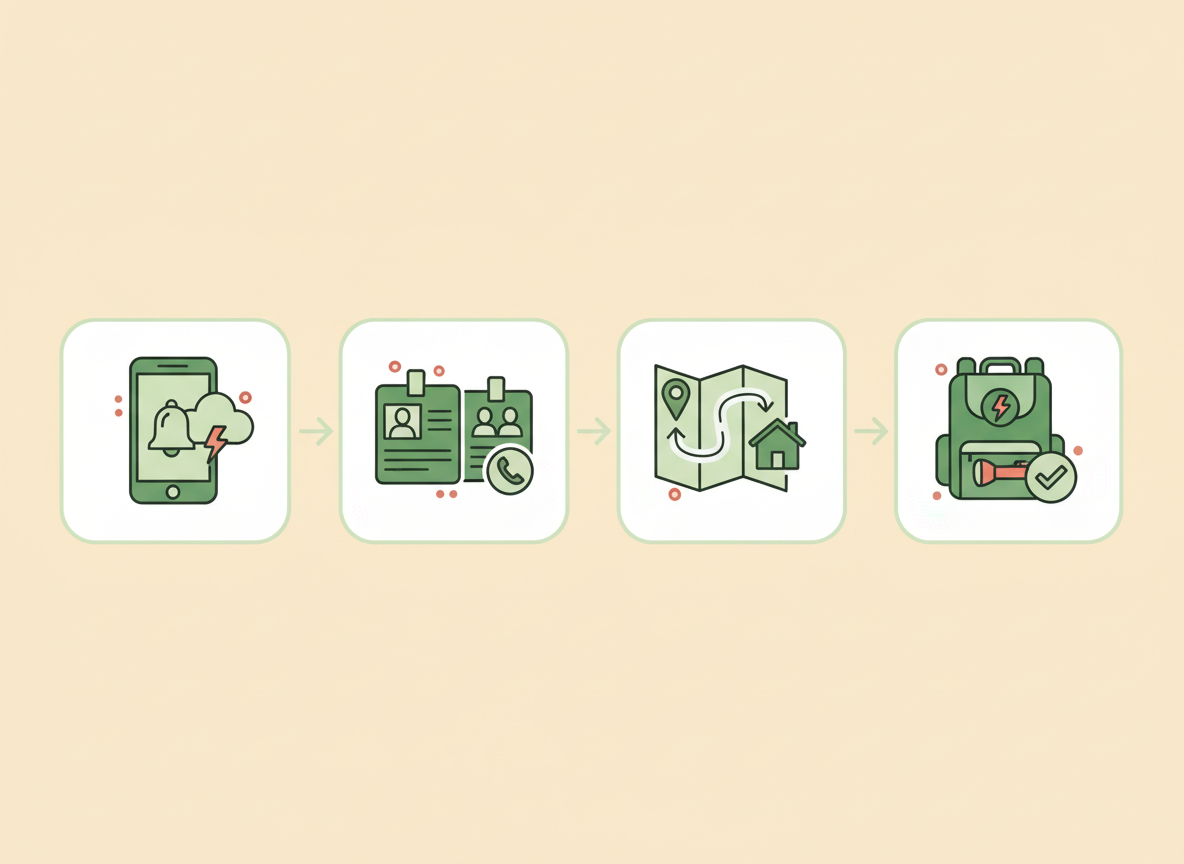
FOUR PLANNING TASKS
Alerts → Contacts → Routes → Practice
Visual explanation: the four icons are a planning reminder, not official evacuation instructions or a replacement for local warnings.
- Check alert sources. Identify your city or county’s official emergency communications and trusted weather alerts.
- Confirm contacts. Agree on primary and backup ways to reach each other without relying on one phone.
- Plan destinations. Identify meeting locations and alternatives, while always deferring to current official evacuation or shelter instructions.
- Rehearse the plan. Practice communication and check the kit; adjust when household circumstances change.
6. A 25-minute family planning session you can repeat
A plan only helps if people can locate and understand it. Hold a short household meeting when everyone can participate. Use plain language, accessible formats, translated copies if needed, and a calm tone for children. Don’t frighten children with fictional disaster forecasts from a chatbot.
- Minutes 0–5: Identify local official alert channels and where the most recent guidance can be found.
- Minutes 5–10: Agree on an out-of-area contact and safe ways to reconnect; confirm consent before sharing numbers.
- Minutes 10–15: Discuss meeting points, transport needs, school arrangements, and pet responsibilities.
- Minutes 15–20: Locate supply kits, emergency contacts on paper, chargers, and any backup equipment.
- Minutes 20–25: Choose a future check-in date and a simple, age-appropriate plan practice. Keep the paper copy where authorized household members can find it.
If you or anyone in your household has an accessibility, healthcare, or communication need, talk directly with relevant service providers or support contacts about an appropriate backup plan. Do not paste a real person’s sensitive medical records into a chatbot in order to generate a checklist.
7. Mistakes that can make a plan less useful
- Assuming AI knows real-time hazards. It may repeat outdated data or fabricate open shelters. Use current official channels during actual incidents.
- Keeping only one online copy. Consider paper and locally accessible copies where appropriate, protected from unauthorized access.
- Writing an unverified meeting place. Accessibility, road closures, official orders, and safety conditions must be checked.
- Ignoring household differences. Infants, older adults, pets, interpreters, mobility and sensory needs can change how a plan works.
- Publishing private contact data. Store personal details with appropriate access, rather than in publicly shareable AI chats or screenshots.
- Never practicing. A plan that nobody understands or can find is not ready merely because it looks polished.
8. A printable final plan review
- We checked our local official emergency alert channels.
- Household members know whom to contact and how to do it when one channel fails.
- Children, school pickup, visitors, and pets have appropriate arrangements.
- Meeting points and possible destinations have been discussed and verified as appropriate.
- We reviewed household-specific kit contents against official guidance.
- Paper and digital copies can be found by authorized family members.
- We did not upload private contacts or medical records into an unapproved AI tool.
- We scheduled a review and a calm practice session.
If any row is unchecked, mark it as a real follow-up task instead of writing ‘complete’ just because the AI created a plan. You can also use our five-step AI answer verification checklist to examine the draft for omissions and invented details.
Official references and editorial limits
- Ready.gov: Make a Plan — household communication, needs, practice.
- Ready.gov: Build a Kit — basic emergency supply considerations.
- Ready.gov: FEMA App — preparedness and alert capabilities.
- Ready.gov: Emergency supply checklist (PDF) — reference list with household-specific adjustments.
Sources reviewed October 10, 2026. Illustrations and examples are fictional, not a verified household preparedness test. Local emergency authorities and qualified professionals determine actual instructions. This is educational planning guidance, not live hazard monitoring, medical advice, or a substitute for an emergency alert.
Next steps: Create a verified home maintenance calendar · Check changing route and schedule information · Keep private records out of AI · Ask for corrections.
Leave a Reply