
PREPARE YOUR SELF-REVIEW
Real evidence · Clear impact · Next goals
U.S. workplace skill guide. All employees, dates, and metrics in this tutorial are hypothetical. Follow the requirements and privacy rules of your actual employer or applicable labor agreement.
Performance self-reviews can feel difficult because ‘I worked hard’ is too vague, while claiming an impressive metric you cannot support is risky. AI can help you organize accurate evidence, improve readability, and rehearse a constructive discussion. It cannot know what you accomplished, grant a promotion, certify that a number is true, or evaluate you on behalf of your manager.
This guide adapts the principles of the U.S. Office of Personnel Management (OPM) performance-management cycle: clarify goals, monitor progress, develop skills, and discuss results. OPM guidance primarily addresses federal workplaces; private employers may use different forms or standards.
You will create an evidence bank, practice describing your actual contribution, produce a short draft with a privacy-safe prompt, and prepare questions for your review discussion. Jump to: What reviewers need · Evidence bank · AI prompt · Worked example · Meeting prep · Final checklist.
1. Start with the expectations your role was actually measured against
Before opening a chatbot, reread your role description, prior agreed goals, review form, and any applicable competency definitions. A sales team, customer support group, research office, and nonprofit program may value different outcomes. Your evaluation period and employer’s documentation rules also matter.
OPM’s performance-management roadmap emphasizes predefined goals, objective criteria, evidence, and employee self-assessment. These are useful habits, not universal U.S. legal requirements for every private employer.
- Goals: Which objectives were agreed at the start or changed during the review period?
- Responsibilities: Which duties were routine expectations, and which were additional contributions?
- Evidence: What dated records, approved metrics, or feedback can independently support each outcome?
- Collaboration: What was your role, and what was accomplished by the broader team?
- Learning: What barriers or skills should you discuss for the next period?
Do not ask AI to rewrite an annual review until it knows which of your generic headings correspond to actual expectations. Even then, AI should improve wording only, not create achievements.
2. Build a small evidence bank before drafting
Use records you are permitted to access: your own project notes, approved performance dashboard summaries, dated deliverables, a list of training completed, and feedback that you may quote or summarize under workplace policy. Collect evidence privately in an approved workspace. Do not paste performance records of coworkers, confidential customer data, or internal financial details into a public AI tool.

COLLECT REAL EVIDENCE
Goal → Contribution → Verified outcome
Illustrative AI-generated office scene. The documents contain no actual employment records or verified individual results.
| Evidence field | What to write | Human review |
|---|---|---|
| Agreed goal | Expected result or standard | Check the actual goal document |
| My action | Specific tasks I personally performed | Separate my role from team work |
| Documented outcome | Approved measure or concrete deliverable | Verify number and date |
| Source | Permitted record or feedback | Use approved internal system |
| Gap or learning | What did not work or needs support | Keep context fair and accurate |
You can find more examples of record-based self-assessment in the OPM employee roles guidance, which describes documenting accomplishments, reflecting on progress, requesting feedback, and identifying development needs.
3. Copy a prompt that cannot invent accomplishments
Create a redacted, general list of verified facts first. A safe drafting prompt can improve structure without receiving private customer names, employee identifiers, medical information, compensation details, unreleased plans, or actual internal spreadsheets. Use an approved enterprise system only when your employer specifically authorizes it.
Act as a careful editor of my performance self-review.
Do not evaluate or invent my employment history.

ROLE GOAL: [verifiable goal without confidential data]
REVIEW PERIOD: [general dates]
ACTIONS I PERSONALLY TOOK: [approved, factual summary]
OUTCOME I CAN SUPPORT: [verified measure or qualitative evidence]
SOURCE OF EVIDENCE: [private note to check offline]
TEAM CONTRIBUTION: [label what others did]
CHALLENGE AND LEARNING: [accurate summary]
NEXT-PERIOD GOAL: [proposal to discuss, not confirmed]

Write:
1. A 130-word professional self-review draft.
2. Three bullets labeled Goal / My Action / Evidence.
3. A fair description of one learning area.
4. Every unsupported claim marked [VERIFY].
5. Three questions I can discuss with my manager.

Do not add numbers, promotions, awards, customers,
titles, certifications, deadlines, or endorsements
that I have not supplied.
After the draft, compare each sentence to your evidence bank. Delete claims that turn a group achievement into an individual award, convert an estimate into a confirmed number, or confuse a planned task with a completed one.
4. Worked example: a believable result is more useful than inflated language
The example below is fictional. It is not a real employee evaluation, AI test result, or recommendation to copy another person’s achievements. Replace all facts with your own truthful, authorized information.
Vague version
“I consistently delivered excellent results, solved every customer issue, and made the team much more productive.”
The problem is not just the vague writing. ‘Every issue’ and ‘much more productive’ imply evidence and an outcome that might not exist. AI should flag those statements, not decorate them with more adjectives.
Evidence-based fictional revision
“During the example review period, I organized a shared guide for recurring customer questions, kept the source instructions current, and worked with my manager to review ambiguous cases. Our fictional tracking record lists 24 guide updates. I would like to assess whether the guide shortened handoff time next quarter; that effect has not yet been measured.”
Notice what changed: the employee names their own action, grounds one number in a fictional record, acknowledges collaboration, and does not invent an efficiency percentage. If your actual record does not support ’24’, remove the number entirely. Honesty is not a weakness in a self-review.
5. Make each achievement concise and traceable
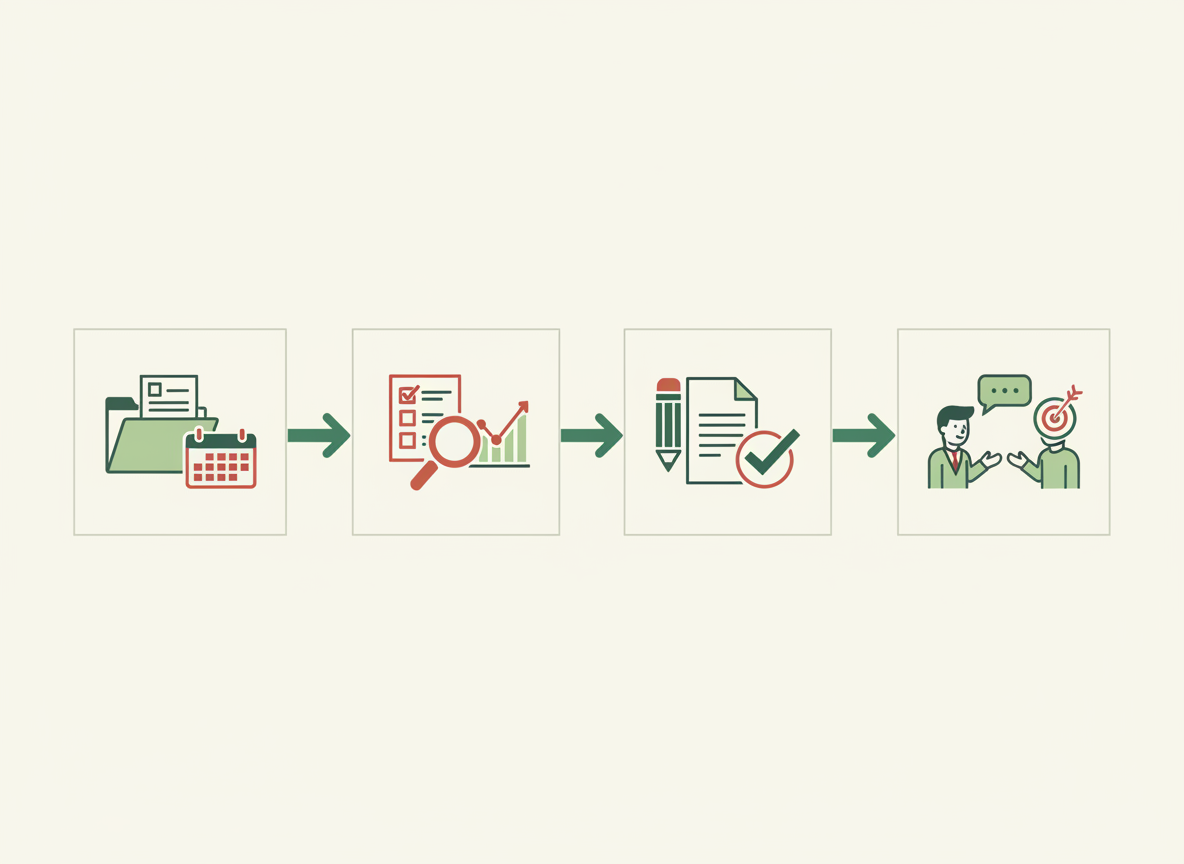
FOUR REVIEW STEPS
Record → Verify → Write → Discuss
Illustrative AI-generated visual: use approved source material and your employer’s real performance criteria for each stage.
- Record: start with a specific goal or problem, the date range, and the notes you are authorized to use.
- Verify: find what can actually prove the task happened or document its result; say ‘not measured’ when appropriate.
- Write: use plain first-person wording for actions you personally performed, then credit shared work fairly.
- Discuss: prepare a question about impact, development, or a measurable next goal instead of making a compensation promise.
An AI tool is useful for asking whether the paragraph is too general, confusing, or repetitive. It is not a source of independent evidence. Never let a chatbot invent performance metrics, customer praise, quotes, project ownership, or dates.
6. Describe a challenge without blame or fabrication
An effective review can acknowledge difficulties without placing sensitive colleagues or customers on trial. Explain the obstacle, what you did within your control, what was still unresolved, and what support might help. Don’t guess another person’s motives or disclose confidential performance concerns about coworkers.
For example, instead of claiming that teammates ‘failed to communicate,’ you might write: ‘Our project handoff process was not consistently documented. I created a draft checklist and asked the team to review it. We are still testing whether it reduces unclear assignments.’ That statement should appear only if it truthfully describes your work.
- Say what you learned from a delay or missed milestone, and distinguish unavoidable constraints from decisions you controlled.
- Name one process improvement you have already completed and one you propose to test.
- If numbers are unavailable, describe the documented output without manufacturing percentages.
- Keep future commitments provisional until your supervisor or organization confirms them.
7. Prepare a respectful 30-minute review conversation
Use a short outline. Most people do not need a ten-page AI-written document. They need a clear summary of goals and evidence, a fair reflection, and questions that invite useful feedback.
- 0–5 minutes: confirm review criteria, period, and any changes to expectations.
- 5–15 minutes: discuss two or three accomplishments with traceable evidence and appropriate team credit.
- 15–20 minutes: reflect on one challenge or skill to improve, without unsupported blame.
- 20–25 minutes: propose a specific next-period goal and ask what evidence would demonstrate progress.
- 25–30 minutes: summarize agreements and ask when written goals, support, or follow-up will be confirmed.
The example timing is a planning aid, not an employer requirement. Your formal HR system may have a different flow. AI-generated rehearsal feedback is a practice tool, not a forecast of rating, salary adjustment, promotion, or your manager’s response.
8. Privacy, bias, and sensitive workplace information
Not every employer permits external AI use on workplace material. Check your organization’s policy before sharing internal documents, customer messages, reviews, proprietary data, or identifiable staff details. A consumer chatbot may have different data handling from an organization-managed AI workspace. The correct choice may be to edit the material entirely inside the employer’s approved tools.
Treat generated language about leadership, personality, or ‘culture fit’ skeptically: an AI system can echo stereotypes or exaggerate confidence. Focus on observed job behaviors and approved criteria. If you believe an evaluation involves discrimination or another legal concern, consult the appropriate HR process or qualified resources rather than relying on a chatbot’s legal conclusions.
Before submitting the document, follow our privacy checklist, and use the five-step AI verification checklist to catch unsupported statements or missing facts. A factual, human-reviewed draft is preferable to an elaborate fictional success story.
9. Final 10-point self-review checklist
- The draft matches the actual review period and employer form.
- Each claimed accomplishment relates to a real goal or responsibility.
- I can identify an authorized record supporting every date and number.
- I separated team results from work I personally performed.
- I did not let AI invent ratings, praise, projects, credentials, or outcomes.
- My wording is readable and professional without exaggerated adjectives.
- I included at least one honest learning area or unresolved question.
- Future goals are specific but clearly proposed until agreed.
- I checked the workplace’s AI and confidentiality rules.
- I read the full draft myself and can explain every sentence.
If you cannot confirm an important claim, remove it or mark it for discussion. A self-review should help you and your manager share an accurate understanding of work—not function as an advertisement written by software.
Official references and editorial limits
- OPM: Performance Management Cycle — planning, monitoring, developing, rating, and rewarding.
- OPM: Performance Management Roadmap — predefined goals, objective records, and self-assessment.
- OPM: Key Employee Roles in Performance Management — employee reflection, documentation, and feedback.
Sources reviewed October 10, 2026. OPM material reflects federal-sector guidance and does not replace private-sector employer policies. The fictional employee and figures are examples, not verified career results. This is general career education, not legal or employment advice, a guaranteed rating, or a salary recommendation.
Related practical guides: Review action items from meeting notes · Turn genuine work history into a résumé · Write an evidence-based workplace email · Suggest a correction.
Leave a Reply