
BUILD AN HONEST PORTFOLIO
Real skills · Clear samples · No fake clients
U.S. freelance skills · Beginner-friendly working guide. All project samples, feedback, figures and clients discussed here are explicitly fictional exercises, not evidence of paying customers or verified income.
A beginner can make a trustworthy portfolio before landing a paying client. What matters is whether a visitor can understand what you offer, inspect an original example, see how you checked the quality, and distinguish practice work from completed customer projects. An AI assistant can help structure and edit your samples. It should never fabricate clients, testimonials, logos, project results, or work experience.
The U.S. Small Business Administration (SBA) recommends understanding potential customers and competitors before investing heavily in a business idea. For portfolio beginners, a narrow service and one good sample are a better experiment than a complicated website claiming success you have not demonstrated.
This guide walks you through an original service sample, copy-ready prompts, an honest fictional case study, accessible layout, privacy and source rights, and a quality check. Jump to: Choose one service · Create a sample · Case-study format · Copy prompt · No fake proof · Rights and AI · Final checklist.
1. Decide what one specific service your portfolio demonstrates
The first portfolio question is not ‘Which AI app makes a pretty website?’ It is ‘Which concrete problem can I solve reliably for a particular audience?’ Select a service you understand well enough to review every final result personally, and make sure it does not demand qualifications, private data, regulated advice, or rights you do not have.
- Public-facing FAQ editing: organize publicly approved product or service facts into an easy-to-read question-and-answer layout. Demonstrate plain language and source checking, not invented company policies.
- Non-sensitive action tracker: transform fictional community event notes into a task table that marks owners and dates as confirmed or unknown.
- Educational blog editing: demonstrate how to remove repetition, check sources, and clarify an article you wrote or have rights to edit; do not pretend search traffic improved.
- Simple research summary: compare publicly accessible, correctly attributed information with a claim-by-claim verification log. Keep confidential or licensed materials out of an unapproved AI tool.
The purpose is not to promise that these are profitable niches. Explore potential demand with our 7-day realistic service-validation guide. A sample shows capability; it does not prove someone will hire you.
2. Create one original project from a fictional brief
Choose a small exercise whose quality a stranger can evaluate in about two minutes. For example, make a fictional neighborhood bicycle repair studio FAQ. The studio is imaginary, and every operational policy, business address, price and customer name must either be omitted or clearly labeled as invented for training. The goal is to demonstrate editing, not to pose as a real business partner.
- Write the brief: ‘Create a one-page FAQ outline for a fictional bicycle repair shop. Use only the five approved fictional facts below.’
- Create source notes: write your own invented, non-sensitive details. Keep the file separate so you can compare them later.
- Draft with AI: ask for structure, clarity and possible missing questions; don’t ask it to invent policies or present unverified advice.
- Human-edit: remove unsupported claims, correct awkward wording and decide which examples genuinely help a reader.
- Label the result: add a visible ‘Independent sample project — fictional brief — no client involved’ note at the top.
- Record a check: show which facts were given, what was changed, what remains unverified, and what you would ask a real client.

SHOW THE WORK
Original brief · Human edits · Verification
Illustrative AI-generated scene. No real project, brand, payment, client, or testimonial is depicted.
Your portfolio should state plainly whether you used AI and what you personally contributed. It is reasonable to say “AI assisted with brainstorming and draft structure; I verified facts and edited the final sample.” Do not claim human fact-checking happened unless it actually did. For a step-by-step editorial review, see our 12-point AI-assisted article editing checklist.
3. Build a small case study with visible limitations
A useful case study is not a dramatic, unverified success story. It shows a real process. The short worked example below is intentionally fictional and should stay labeled that way anywhere you publish it. There was no real client, payment, interview, before/after business result, or measured traffic.
Fictional example: local FAQ editing sample
| Case-study element | Honest sample text |
|---|---|
| Project label | Independent sample — fictional bicycle repair studio |
| Problem | An imaginary FAQ has scattered, repetitive questions |
| My role | Writing, editing, information structure and review |
| Input | Five invented shop-policy notes that are labeled fictional |
| Output | One original 8-question FAQ draft |
| How AI assisted | Brainstormed question categories and suggested wording |
| Human checks | Compared all answers with invented source notes; removed unsupported statements |
| Result claim | No customer, conversion, revenue or SEO outcome claimed |
| Client approval | Not applicable — no client |
Before-and-after text without invented business results
Fictional rough draft: “We can fix every bike quickly, offer the best price, and finish any repair the same day.” This line makes several promises with no basis in the sample notes.
Human-reviewed sample: “What repairs can be requested? Bring a description of the issue and ask the shop to confirm its available services, estimated turnaround and written quote.” Even in an invented example, do not publish the latter as a real company policy. It demonstrates a cautious editorial decision.
To make the sample genuinely yours, use your own creative wording, organize the page, check the claims and describe the revision choices. Merely relabeling a complete generated page as your paid client work is not a sound substitute for demonstrated skill.
4. A copy-ready AI prompt for one honest portfolio sample
The prompt below has safeguards against inventing a client or market result. Replace brackets with fictional non-sensitive material you wrote or public facts you are authorized to use. Review and rewrite the output yourself.
You are assisting me with an INDEPENDENT PRACTICE PROJECT.
This is fictional sample work, not a real customer assignment.
My chosen service: [one narrow service].
Audience and problem: [fictional audience and need].
Approved facts or sample materials: [ONLY safe, invented or
licensed information I have permission to use].
My actual skill contribution: [what I will write/check/edit].

Please return:
1. A one-sentence project scope.
2. A small original example deliverable, under 250 words.
3. A suggested case-study outline:
   Brief | My Role | Input | Process | Checks | Output.
4. A list of unknown details marked [NOT VERIFIED].
5. A short disclosure: "Independent fictional sample;
   no client, paid project or outcome demonstrated."
6. Three questions a real potential buyer might ask.

Do not invent client names, reviews, screenshots,
earnings, traffic statistics, awards, licenses, test results,
sales or quote approvals. Do not claim that AI checked
facts against sources it has not received.
The next step is not instant publication. Read the sample, rewrite weak sentences, validate that it represents your own work, and confirm that any included illustrations or icons are appropriately licensed. If you cannot explain an image, data point, or claim, remove it.
5. Arrange your portfolio for a real reader, not an AI grader
For a single-page beginner portfolio, give the visitor a direct answer to five questions: What service is offered? For whom? What does a completed, checked example look like? How can a prospect ask a question? What is the current level of experience? Avoid decorative animations that slow reading or hide important terms.
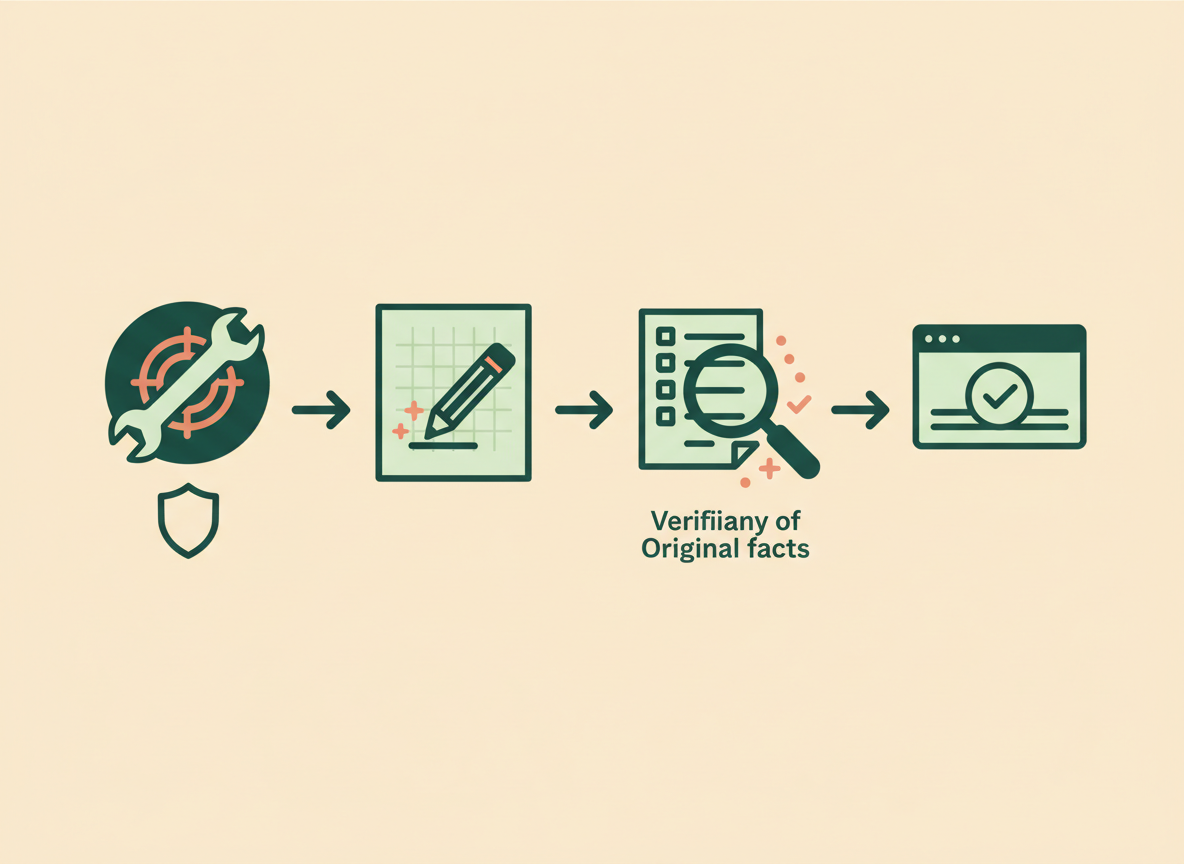
FOUR PORTFOLIO STEPS
Choose → Create → Verify → Label
AI-generated process illustration. These are four useful editorial actions, not an approved certification framework.
- Simple introduction: ‘I help [audience] with [specific, lawful service] by producing [deliverable].’
- Sample gallery: one to three clearly identified sample projects, each linking to the work or a readable page; avoid showing misleading stock client logos.
- Process: explain the input requirements, editing and review steps, delivery type, and questions that require client approval.
- About/experience: state relevant skills, tools, and training accurately; do not imply that a personal exercise was commissioned by a buyer.
- Contact: show an accessible email or contact form without requiring a visitor to provide extra sensitive details merely to ask about your scope.
On a mobile phone, keep headings concise, use readable contrast, make sample thumbnails legible when small, avoid text cramped into images, and ensure every illustration has descriptive ALT text. Provide plain-text descriptions under images so a person can understand the method even when images do not load.
6. Never use generated testimonials or fictional client logos as proof
The Federal Trade Commission’s Consumer Reviews and Testimonials Rule guidance explains restrictions on fake and false testimonials, including content that misrepresents whether the supposed person existed or experienced a product or service. An AI-written endorsement is not a genuine customer opinion just because the person sounds realistic. Rules apply depending on the nature of the claim and business practice.
- Do not create imaginary testimonials: avoid fake star ratings, invented client quotes, invented business outcomes or synthetic ‘verified buyer’ identities.
- Do not simulate client screenshots: fictional portfolio examples must not look like a genuine paid job’s approval email, project dashboard, or customer praise.
- Do not imply real traction: never claim that a mock FAQ ‘increased conversion by 45%’ or ‘ranked first on Google’ without reliable documented evidence.
- Disclose practice status: put ‘fictional example’ where a reader will see it before interpreting the project as actual experience.
- Separate your editorial views: paid endorsements, review incentives, or material relationships can require additional disclosures and must meet applicable rules.
The FTC’s Advertising and Marketing guidance also emphasizes that business advertising claims should be truthful, not misleading and backed by evidence. If you have no paying clients, say so, or simply present your work as independent sample projects. This can build more trust than invented social proof.
7. Check copyright, client permissions, and AI-generated artwork
The U.S. Copyright Office has explained that copyright analysis of generative-AI output depends on sufficient human authorship, creative selection, coordination or modification; prompting alone is not necessarily enough. This is a nuanced, case-specific subject, not a blanket declaration that every AI illustration is free to reuse.
Before adding an asset to your portfolio, record where it came from, what the applicable license or platform terms permit, whether it depicts a real person or brand, and which parts you created. Don’t take another freelancer’s sample, remove their name, and show it as yours. For real clients, get appropriate permission before sharing deliverables, internal files, unpublished plans, or personally identifying data.
- Owned original work: your own writing, sketches and checks are usually the simplest starting point; still consider whether other assets are licensed.
- Fictional demonstration: use made-up company names only when clearly marked as fictional, and avoid confusing existing trademarked brands.
- Client work: do not display it publicly merely because you delivered it. Respect confidentiality, publication and ownership agreements.
- AI-created artwork: do not promise exclusive copyright ownership without reviewing relevant rights, facts and contracts.
- Private data: never paste clients’ actual contact lists, recordings, internal documents, payment details or sensitive personal information into a consumer AI tool without authorization.
Our AI Prompt Privacy Checklist gives a six-part process for deciding what should stay out of a public chat. Legal ownership and disclosure questions may require qualified advice.
8. Ask for feedback on the work, not a fake endorsement
When you have one honest sample, ask a relevant person whether they understand the promised output and what they would change. A request for critique is not the same as soliciting a fabricated customer review. Do not automatically publish personal replies as testimonials. If you contact anyone, follow their communication preferences and applicable outreach rules.
Subject: Could you review a short example of my work?

Hello [Name],

I am exploring a focused service: [deliverable for audience].
I made a short INDEPENDENT PRACTICE SAMPLE using fictional
information. It is not an example from a paying client.

Would you be willing to look at the example and tell me:
1. What part is genuinely useful?
2. What is unclear or missing?
3. What would you need before considering a real proposal?

There is no purchase request and no expectation of a testimonial.
If now is not a good time, please feel free to ignore this.

Thank you,
[Your name]
Record feedback privately and only with permission. Revise the sample based on identifiable usability problems—unclear headings, poor readability, missing verification—not on a desire to make the portfolio appear more successful than it is.
9. Final 10-point portfolio quality checklist
- The first screen identifies one clear audience and service.
- Each sample is my own work or material I am authorized to use.
- All fictional projects are visibly labeled independent practice.
- I explain what AI did and which edits or checks I performed myself.
- I make no imaginary client, revenue, traffic, or performance claim.
- I have verified every public fact, link, caption and stated result.
- I checked image rights, ALT descriptions and mobile legibility.
- Confidential details, credentials and client records were not uploaded without authorization.
- The visitor can inspect at least one actual deliverable and contact me safely.
- My offer, revision scope, timeline, price and qualifications are not overstated.
When all ten checks pass, you have a truthful demonstration of a specific skill—not proof of income or automatic customer acquisition. The next appropriate step is to test real interest and refine the service based on feedback, not to buy exaggerated success claims.
Official sources and editorial limitations
- U.S. Small Business Administration: Market Research and Competitive Analysis — testing audience demand and differentiation.
- FTC: Consumer Reviews and Testimonials Rule Q&A — fake and false reviews and testimonials.
- FTC: Advertising and Marketing — truthful substantiated business claims.
- U.S. Copyright Office: Copyright and AI, Part 2 Announcement — meaningful human contribution and case-specific rights.
Editorial review: October 11, 2026. All examples and amounts are fictional. This is educational guidance, not a professional legal or copyright opinion, actual client case study, paid service test, guaranteed revenue, or assurance of advertising approval. Verify the current rules and terms applicable to your business and use of AI tools.
Continue: Test three service ideas in seven days · Learn a human editing workflow · Create a useful AI-assisted blog · Suggest a correction.
Leave a Reply