
An online subscription can look inexpensive at checkout and still be the wrong choice for the way you actually use it. A month-to-month plan may be flexible but costly over time; an annual plan may look cheaper per month while requiring a larger payment now. Free trials, automatic renewal, taxes, cancellation rules, and limits on features can change the decision. This guide shows how to use AI as a comparison assistant without treating its answer as a verified offer.
You will learn a repeatable method to collect current terms from the provider, compare the same usage period, calculate a realistic cost, and record what to check before clicking Subscribe. Every price and provider in the worked example is fictional; this is not a review of any particular AI service, app, or company.
Step 1: define what the subscription must do
Begin with one specific task rather than the provider’s biggest feature list. For instance, you might need a writing assistant twice a month, a file tool for a short project, or recurring cloud storage. Decide which features are essential, what you can do without, and how many months you realistically expect to use the service.
- Must-have capability: Identify the two or three features that make the subscription worthwhile.
- Usage: Will you need it weekly, for three months, or continuously for the next year?
- People and devices: Check any seats, simultaneous-device, household-sharing, and usage-limit conditions.
- Data and cancellation: Decide what information you may upload and whether easy cancellation matters more than the lowest long-term price.
- Budget: Set both a comfortable upfront payment and an overall spending limit.
If you only need a tool for a short assignment, a lower total commitment may matter more than a lower advertised average monthly price. If a plan does not support a must-have feature, remove it from the comparison even if the price is attractive.
Step 2: collect the current offer from the original source
Open the provider’s current pricing page and any linked billing, renewal, cancellation, refund, privacy, and fair-use terms. Record the page link and the date you checked it. Copy only the relevant public text into your AI tool rather than relying on the tool to remember current prices. If a provider presents multiple price versions by location, currency, seat count, or promotion, note which version applies to you.
- Record the actual amount charged now: a monthly invoice, upfront annual charge, or trial enrollment with future paid billing.
- Check whether taxes or mandatory fees are included in the displayed amount, and whether currency conversion may affect your card.
- Find the first paid renewal date and the billing frequency after any introductory promotion.
- Check what occurs if you cancel: when service access ends, whether a refund is possible, and whether cancellation stops only renewal.
- Review features and limits for the exact tier; avoid assuming the advertised headline feature is included in every plan.
The U.S. Federal Trade Commission (FTC) advises consumers to read trial and auto-renewal details, understand how to cancel, and keep records of cancellation attempts. These are practical precautions even when you use AI to organize an offer. FTC consumer guide to free trials, auto-renewals, and subscription cancellation explains why recurring charges deserve careful review.

COMPARE THE REAL TOTAL COST
Illustration: Use one time horizon for both options; headline monthly equivalents can hide a different payment commitment.
Step 3: ask AI to extract terms, not to invent them
Use an AI assistant to organize the text from official pricing and terms pages you have inspected. Do not send card numbers, addresses, account logins, past bills showing full personal details, or customer information. If you need to compare your own statements, redact identifying information first and use an approved service.
Act as a careful subscription comparison assistant.

My use case: [specific task]
Expected duration: [3 months / 12 months / uncertain]
Must-have features: [short list]
Comfortable upfront budget: [amount]
Currency and location: [e.g., USD, United States]

I will provide official pricing, renewal and cancellation
terms for each plan. Use only the supplied terms.
DO NOT invent current offers, fees, trials, renewal dates,
refunds, cancellation options, or feature availability.

Produce a table with:
- Plan and exact source link
- Monthly or yearly amount and when it is actually charged
- Total expected charge for my usage duration
- Mandatory fees/tax status if known
- Trial end, billing frequency, and renewal conditions
- Cancellation steps, notice periods and refund limitations
- Must-have feature match and usage limits
- Unverified questions I must confirm myself

Show the arithmetic for every price comparison.
Mark missing conditions "not verified from supplied terms."
Separate quoted contractual terms from your interpretation.
Recommend a plan ONLY if its required features and costs
are actually supported by the sources.
Have the AI list disputed or missing details as questions rather than filling them with confident-sounding guesses. Check amounts and cancellation wording yourself before paying, and keep a copy of the relevant terms.
Step 4: compare the same real-world usage period
Here is a transparent fictional example. Imagine two plans with identical features and no taxes or extra fees for simplicity. The monthly plan charges $12 every paid month. The annual plan charges $96 upfront for 12 months. The example assumes the annual payment is not refunded for early cancellation; real services may have different policies and you must check them.
| Question | Monthly plan (fictional) | Annual plan (fictional) |
|---|---|---|
| Amount actually billed | $12 each paid month | $96 upfront for 12 months |
| If used for 3 paid months | 3 × $12 = $36 | $96 paid upfront |
| If used for 12 paid months | 12 × $12 = $144 | $96 paid upfront |
| When total charges are equal | 8 × $12 = $96 | $96 |
| Refunds / cancellation | Must check provider terms | Must check provider terms |
Worked decision: If the service is needed only for three paid months and the annual plan is not refundable, the monthly plan costs $36 versus $96. For 12 paid months, the annual plan costs $96 versus $144, a $48 difference before any tax or fees. At eight paid months both options total $96. None of those outcomes proves which plan is best if feature limits, discounts, refunds, or future prices differ.
Use this simple formula only when the billing terms really are that straightforward:
Monthly plan for N paid months = monthly price × N
Annual commitment = upfront amount + applicable fees

Compare the charge for the SAME expected usage period.
Do not count a free trial as free if it converts to a
paid subscription you forget to cancel.
Watch for an annual commitment billed monthly
A plan that says “$9 per month” may actually require a 12-month commitment paid in installments. It is not the same thing as a $9 month-to-month plan that you may cancel at any time. The U.S. FTC has warned about unclear annual-paid-monthly subscription terms and early termination charges. The exact legal obligation depends on the offer you accept.
| Hypothetical offer | What is charged | What to verify if leaving after 3 months |
|---|---|---|
| True monthly plan at $12 | $12 for each paid month; 3 months = $36 | Does cancellation stop the next month’s payment? Check notice terms. |
| 12-month commitment, billed $9 monthly | $9 each month; 12 scheduled payments total $108 | Three paid bills total $27, but that is not proof the commitment costs only $27. Check any remaining obligation, notice period, and early termination charges. |
| Annual prepaid at $96 | $96 at the start for the agreed term | Whether any portion is refundable depends on the actual terms. |
Ask AI this: “For each quoted plan, identify the contract commitment length separately from the payment frequency. Quote the exact cancellation or early termination clause from the official terms. Calculate the full scheduled obligation, and mark any unknown exit cost as not verified.”
All prices above are fictional illustrations, not live subscription offers or a statement that a particular fee will apply. Read the provider’s original contract before purchase.
Step 5: check trials, renewal, and cancellation separately
The FTC’s consumer advice notes that some offers automatically begin charging after a free trial. Before enrolling, learn exactly when billing begins, which payment method is charged, whether a reminder is offered, and where the cancellation instructions live. Do not rely on an AI-generated date unless you verified it against the actual terms and your time zone.
- Free trial: Record the start, first paid date, initial rate, subsequent rate, and required cancellation process.
- Automatic renewal: Identify the renewal frequency, charge amount, and any deadline for stopping the next term.
- Cancellation: Find the official account process and whether cancellation is immediate or takes effect at the next billing date.
- Refunds: Look for annual-plan refunds, pro-rated payments, and non-refundable fees; do not assume any are offered.
- Proof: Save your cancellation confirmation and check subsequent account statements if you decide to end the service.
The Consumer Financial Protection Bureau (CFPB) explains an important distinction: stopping automatic payments from a bank account does not itself cancel the underlying contract or amount owed. Cancel the service agreement through the provider’s process as well, and follow your bank’s procedures if payment authorization is in dispute. See the CFPB’s automatic-payment guidance for details. Applicable protections and steps depend on the payment method and situation.
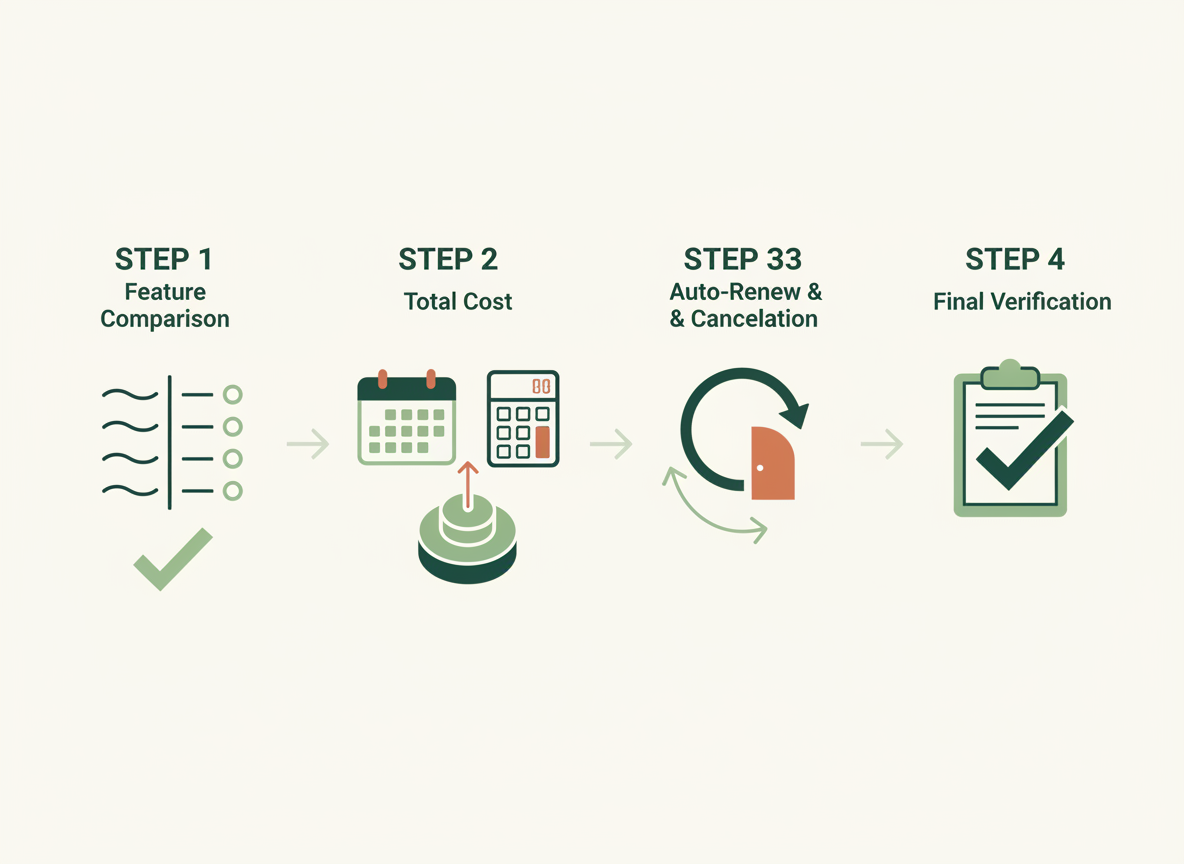
FEATURES → COST → TERMS → DECISION
Illustration: The least expensive headline is not automatically the most suitable subscription.
Step 6: record your decision so you can review it later
Once you have verified the terms, copy a concise decision note into your own calendar or notes app. This is more useful than a generic AI recommendation because it captures what you actually agreed to.
Subscription decision record
Service and exact tier: [name]
Official pricing URL: [link]
Official cancellation terms URL: [link]
Terms checked on: [date]
What I need this for: [task]
Expected useful duration: [months]
Amount billed now: [amount]
Next possible charge: [date / not verified]
Total cost over my horizon: [show calculation]
Taxes / fees: [confirmed / not verified]
Renewal / cancellation conditions: [verified details]
Important features or usage limits: [details]
Reminder before renewal: [date]
Outstanding questions: [list]
Decision: [month-to-month / annual / wait / no purchase]
If you are undecided, a valid outcome is wait and verify. You do not have to subscribe merely because AI ranked one plan first. Reopen the decision note before renewal to check whether you still use the product enough to justify the charge.
Common mistakes to catch before paying
- Comparing different durations: A monthly price and a full annual prepaid price are not directly equivalent.
- Overlooking a trial conversion: “Free today” may lead to paid recurring charges later.
- Ignoring the feature tier: A cheap plan may lack the one capability you need.
- Invented terms: AI can confidently fabricate cancellation rules, taxes, refunds, and renewal dates.
- Assuming stopping a payment cancels a contract: Contract termination and payment authorization may be separate.
- Uploading sensitive bills: Remove personally identifying details and card data before using any AI comparison service.
- Forgetting changing terms: Recheck prices and the terms relevant to your account immediately before purchase.
Seven-point subscription review checklist
- Can I explain the real task and expected months of use?
- Did I verify each plan’s current features from the seller’s official page?
- Did I calculate what I would actually pay for the same duration?
- Did I identify any trial, recurring renewal, tax, or extra charge?
- Do I know the steps and timing to cancel the service itself?
- Did I record source links, a check date, and unresolved questions?
- Am I choosing based on confirmed features and costs, not an AI guess?
Frequently asked questions
Can AI check subscription prices automatically?
Some tools can browse current webpages, but their information may be stale, incomplete, or drawn from a different region or plan tier. Compare the output against the provider’s official pricing and billing terms immediately before purchasing.
Is an annual plan always cheaper?
Not necessarily for the time you will use it. An annual plan can reduce the average cost if you need the service long enough, yet cost more out of pocket for a short project if no refund is available. Compare equivalent periods and the actual cash payment.
Does canceling a bank transfer end a subscription?
Not by itself. The CFPB explicitly distinguishes revoking automatic payment authorization from canceling the contract. Follow the provider’s agreement and the payment institution’s guidance for your situation.
What if the plan leaves out its cancellation terms?
Treat those conditions as not verified, contact the provider, and avoid relying on an AI assistant to fill in the gaps. Keep records of important communications and terms.
Official references and related AI guides
- FTC Consumer Advice: getting in and out of free trials and auto-renewals — check recurring charges and cancellation options before enrolling.
- FTC Consumer Advice: how to stop subscriptions you never ordered — cancellation records, unwanted charges, and disputes.
- CFPB: How do I stop automatic payments from my bank account? — separate payment authorization from the underlying contract.
- How to summarize a PDF with AI and verify important details — apply the evidence-checking method to a provider’s public PDF terms.
- Plan a realistic workday with AI — decide if a subscription actually fits your recurring workflow.
Official references checked October 9, 2026. The $12 monthly and $96 annual plans, example comparisons, and illustrations are fictional teaching material, not live offers, product tests, or legal or financial advice. Actual billing, taxes, renewal policies, and consumer protections depend on the provider and situation; consult the applicable official terms before paying.
Leave a Reply