
You can use an AI assistant as a patient practice interviewer: it can ask one question at a time, prompt for clearer examples, and help you rehearse a shorter answer. The catch is that a fluent answer is not the same as a truthful or convincing one. Your goal is to talk clearly about work, school, volunteering, or other experiences you actually have—not to memorize impressive achievements invented by software.
This guide provides a practical, low-cost mock-interview routine for a U.S. job seeker, with two ready-to-copy prompts, a worked fictional example, a feedback scorecard, and privacy checks. It does not promise a job offer or present its fictional answers as observed results from an actual interview.
Step 1: turn the job posting into a preparation brief
Start with the current job description and the hiring employer’s official website. Pick three skills or responsibilities that appear most central. A role that asks you to resolve customer issues, document cases, and coordinate with a team deserves different stories from a role built around financial analysis. If the posting is vague, write that uncertainty down instead of asking AI to guess what this employer expects.
- Role: Exact job title and location or remote arrangement.
- Evidence to prepare: Three essential skills, one task you have already completed, and one skill you are still developing.
- Interview format: Phone, video, panel, or in person; confirm with the genuine recruiter.
- Your questions: Two or three questions about responsibilities, success measures, and the team’s current challenges.
The U.S. Department of Labor’s CareerOneStop interview preparation guide recommends researching the employer, rehearsing responses with examples from your background, preparing questions for the employer, and making a plan for the interview day.
Step 2: build a truthful bank of three stories
Before asking AI to make you sound polished, identify three specific experiences you can discuss truthfully. These might come from paid work, school, a community project, a side project, or volunteering. If you are new to the workforce, explain the context honestly. Do not turn a class exercise into a claim that you managed paying customers.
An optional framework is Situation → Task → Action → Result. Use it to organize your memory, not to invent metrics. If you did not track a percentage improvement, describe the observed result in ordinary words. Include uncertainty when you do not know the outcome.
Story 1 — solving a problem
Situation: [what was happening]
Task: [what you personally needed to do]
Action: [what you actually did, not what the team did]
Result: [what you observed or can document]
What I learned: [one honest lesson]

Story 2 — working with others
Situation / Task / Action / Result / Learning: [...]

Story 3 — learning a skill or recovering from a mistake
Situation / Task / Action / Result / Learning: [...]

Rule: No invented jobs, certificates, customers,
results, numbers, or responsibilities.
Keep a separate line for what you want the interviewer to remember: the ability you demonstrated and its relevance to the role. An AI assistant can help with wording, but it should not quietly replace vague facts with fabricated success claims.
Step 3: generate realistic questions and a mock-interview plan
Paste an appropriate, non-confidential excerpt of the job posting and a short list of your real experience. Ask for questions that match the role and your level. CareerOneStop also distinguishes traditional, behavioral, and situational questions, so practice more than one kind rather than ten versions of “Tell me about yourself.”
Act as a respectful mock interviewer for this job:
[role title and public job description excerpt]

My real background (non-sensitive summary):
[skills and experiences I can truthfully describe]
Experience level: [entry / mid-level / changing careers]
Interview format: [phone / video / in person]
Time available: [e.g., 15 minutes]

Ask ONE question at a time, alternating among:
- general fit and motivation
- behavioral questions about what I actually did
- a plausible work scenario for this role

After each answer, ask up to two helpful follow-up questions.
Do not invent my credentials, employers, results,
salary history, or details about the hiring company.
Do not claim your questions match the actual interview.
After five questions, offer an evidence-based scorecard
and tell me which claims need fact checking.

PRACTICE YOUR REAL STORIES — NOT INVENTED ONES
Illustration: Read the question out loud, answer in your own voice, then use the AI’s suggestions as revision notes.
Step 4: answer one question aloud and check what AI changes
A mock interview works best when you speak or type a first answer without chasing perfect wording. Try responding in roughly a minute for a straightforward behavioral example, then revise for clarity. The exact ideal length depends on the question and interviewer, so do not let a generic timer override a clear, relevant answer.
Worked example: customer support coordinator
Fictional teaching example: A candidate for a customer support coordinator role once helped a student club organize an event. The club received duplicate questions about the schedule, so the candidate gathered approved information, made a shared FAQ document, and posted updates. The candidate did not track the number of messages or measure a response-rate improvement.
Interview question: “Tell me about a time you improved a confusing process.”
Weak first answer: “I am great at communication and fixed our whole system.” It says little about what happened.
Truthful improved answer: “While helping organize a student club event, I noticed people kept asking where to find the correct times. I checked the schedule with the organizers, made a shared FAQ, and used it when answering questions. It gave our volunteers a consistent place to point people. I didn’t measure the impact, but I learned that confirming the source before writing an update prevents confusion.”
Unsafe AI revision to reject: “I led a 12-person customer-success team and cut support tickets by 60%.” Nothing in the fictional source story supports that claim. Delete it, even if it sounds more impressive.
Step 5: ask AI for a fair feedback scorecard
Ask AI to critique the answer, not to predict whether an employer will hire you. It has not observed the real interviewer, and it cannot know how your experience compares with other candidates. A useful critique identifies specific strengths, ambiguities, and unsupported statements instead of producing an arbitrary “92% hire probability.”
Review only the interview answer I just gave.
Use this simple 0–2 scale for each area:
0 = missing, 1 = partly shown, 2 = clearly shown.

A. Did I answer the specific question?
B. Is the story understandable to a new listener?
C. Did I state my OWN actions clearly?
D. Is the result honest and supported by my notes?
E. Is the answer relevant to this role?

For every score, quote a short phrase from my answer
as evidence. If you cannot substantiate a judgment,
say "not enough evidence."
Suggest ONE shorter truthful revision.
Flag any exaggerated or invented achievement.
Do not grade my accent, personality, age, or identity.
Do not predict whether an employer will hire me.
Treat the score as a self-coaching aid, not an objective hiring assessment. A friend, mentor, career counselor, or American Job Center mock interview can provide additional human feedback. CareerOneStop notes that American Job Centers may offer free mock-interview assistance.
Step 6: prepare questions for the employer and the interview day
A good interview is also your chance to assess the job. Prepare a few questions you actually care about. For instance, ask how new hires learn the systems, which goals matter during the first three months, or how the team measures successful work. Adapt them to what you learned from the employer’s own website and job posting.
- Ask: “What would success look like in this role in the first 90 days?”
- Ask: “What types of problems does the team need this hire to solve first?”
- Ask: “How is training provided for the tools and processes mentioned in the listing?”
- Verify logistics: Interview time and time zone, real location or meeting link, interviewer names when provided, and any materials requested.
- For video calls: Test your connection, microphone, camera, lighting, and a quiet background before the meeting.
The CareerOneStop virtual interview guide recommends checking the technology, researching the role, preparing the setting, and doing practice runs. A written AI rehearsal is not a replacement for checking how you actually sound and appear on a call.
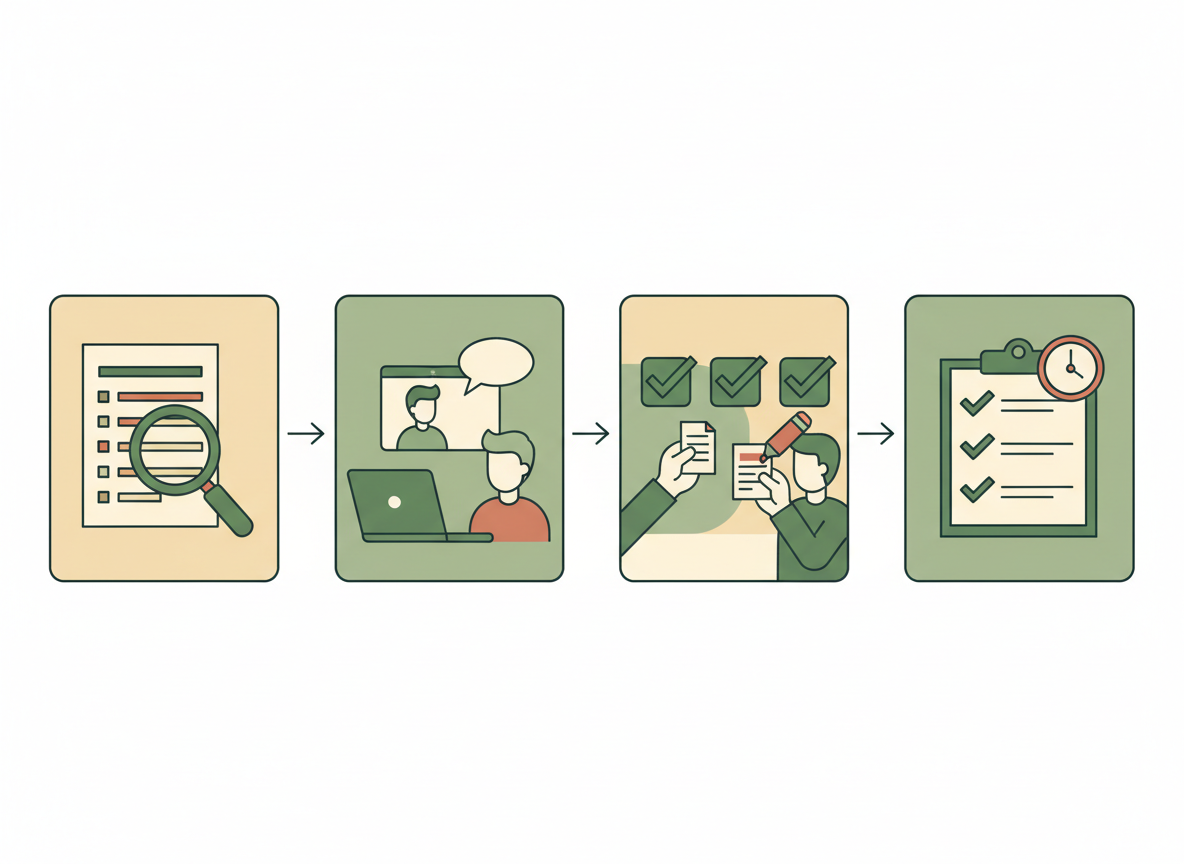
READ THE ROLE → REHEARSE → VERIFY → REFINE
Illustration: Keep your practice grounded in an actual job posting and your own experience.
A 25-minute practice session you can repeat
| Time | Practice task |
|---|---|
| 0–5 min | Read the job description and select two skills to demonstrate. |
| 5–10 min | Write brief notes for one real story; keep dates and results honest. |
| 10–20 min | Let AI ask three questions, one at a time, and answer each aloud. |
| 20–23 min | Review the scorecard; remove one unsupported or unclear statement. |
| 23–25 min | Choose one employer question and verify the interview logistics. |
This schedule is an illustrative practice template, not a measured training protocol. If you need more time to prepare, expand it. Consistent, truthful practice matters more than racing through questions.
Protect your information and watch for fake recruiters
For practice, use a job-description excerpt and a general background summary instead of uploading your full résumé with address, phone number, references, identification numbers, or confidential employer information. Review the privacy controls and retention policies of any AI service before sharing files or recordings.
The U.S. FTC warns that fake recruiters may seek banking details or identity information before legitimate hiring steps. Verify suspicious recruiting messages through the employer’s own independently located website or contact channels, not just the phone number or link provided in the message. Do not pay a stranger for equipment or training as a condition of receiving a supposed job offer.
- Never give AI a real candidate’s sensitive records just to rehearse a general interview question.
- Do not let AI fabricate education, work history, customers, awards, credentials, metrics, or references.
- If a recruiter requests urgent financial or identification details before you can independently verify the company and process, stop and check.
- If a practice question seems biased, inappropriate, or unrelated to the role, do not treat an AI-generated answer as legal advice; consult relevant official guidance or qualified assistance.
Five checks before your real interview
- Can I explain three skills required by the actual job posting?
- Can I tell two or three authentic stories without embellishment?
- Did I practice answering aloud, not only reading AI-generated scripts?
- Are my interview time, location or video link, and employer identity confirmed?
- Can I ask two thoughtful questions about the job and explain what I would learn or contribute?
Frequently asked questions
Will AI practice guarantee I get hired?
No. AI can make rehearsal convenient, but hiring decisions depend on role requirements, interviews, organizational decisions, and other factors. Your practice should improve clarity and help you spot weak or unsupported claims.
Can I practice without a résumé?
Yes. Start with your education, volunteering, personal projects, transferable skills, and honest learning goals. Tell the assistant when you lack direct experience rather than asking it to invent one.
Is a video mock interview better than text practice?
They practice different things. Text can help you structure an answer; speaking practice can help with pace, clarity, and comfort. Choose a method that suits the actual interview, your accessibility needs, and the privacy choices available.
Should I memorize AI-written interview scripts?
Memorizing exact scripts can make answers sound unnatural or cause you to overstate facts. Practice recalling key evidence in your own words so you can respond flexibly when a question changes.
Before the interview: Our AI résumé improvement guide shows how to prepare accurate, job-relevant bullets without inventing achievements. Use those verified examples to make your mock-interview answers more concrete and consistent with your application.
Applying before the interview? Prepare your honest experience in the AI cover-letter guide. It helps you connect real examples to the job posting before you rehearse the same evidence in an interview.
Official guidance and related practical AI guides
- CareerOneStop: Get ready to interview — employer research, practice, questions, and interview preparation.
- CareerOneStop: Common interview questions — traditional, behavioral, and situational examples.
- CareerOneStop: Virtual interviews — video setup and practice guidance.
- FTC Consumer Advice: Job scammers are looking to hire you — warning signs of fake recruiters and requests for private information.
- Use AI to draft a professional work email — useful for reviewing a post-interview thank-you note.
- How to summarize a PDF without inventing details — check a public job description or approved document against its source.
Official references checked October 9, 2026. The student-club story, practice scorecard, and schedules are fictional instructional examples. Illustrations are AI-generated, not photographs of a real interview participant. This article provides general job-search education, not hiring guarantees, legal advice, or proof of testing with a specific employer.
Leave a Reply