
A useful cover letter explains why your real experience fits a particular job. An AI assistant can help make that explanation shorter and clearer—but it can also invent achievements, repeat the same generic compliments about every employer, or introduce mistakes into names and dates. Your job is to supply verified facts, check the draft, and decide what to send.
This U.S.-focused guide walks through seven practical steps. You’ll get an evidence-matching worksheet, two copy-ready AI prompts, a fictional example, a final verification checklist, and links to official CareerOneStop and USAJOBS instructions. This method does not guarantee an interview or hiring result.
Step 1: find out whether you should include a cover letter
Start with the employer’s live application instructions. Some listings require a cover letter, some label it optional, and many say little about one. If required, follow the stated instructions and address any specific questions. If optional, include a letter when it adds a meaningful explanation of your fit, interest, or career transition. If the employer expressly prohibits extra documents, respect that rule.
The U.S. Department of Labor’s CareerOneStop cover-letter guide explains that an employer-requested letter should be supplied and that an optional letter can highlight relevant experience. It also notes that when an employer specifically asks for an emailed résumé, the email body may function as the cover letter. The posting always takes priority.
- Required: Check format, page or word limit, questions, and submission deadline.
- Optional: Add information that the résumé alone cannot clearly convey.
- No explicit request: Look for application-system options and prioritize any stated employer instructions.
- Federal jobs: Read each USAJOBS Required Documents and How to Apply section; not all listed documents are mandatory for every applicant.
Step 2: match job requirements to evidence from your experience
Highlight two or three responsibilities from the job description. Next to each, write down what you actually did and where you can verify it. Paid work, volunteering, school assignments, and personal projects can all demonstrate transferable skills when described accurately. Keep the original context. A class project is not a corporate management role.
| What the job needs | Your honest supporting example | Unsupported claim to reject |
|---|---|---|
| Clear communication | Shared confirmed event details with a student group | Managed a nationwide client-service team |
| Organization | Kept a volunteer schedule current | Created a major corporate scheduling system |
| Collaboration | Coordinated with several event volunteers | Led 50 employees and improved productivity 70% |
Fictional example: The table above is instructional, not an actual applicant’s record. If you did measure a real result, you may use the verified number. If not, an accurate qualitative description is better than an invented percentage.
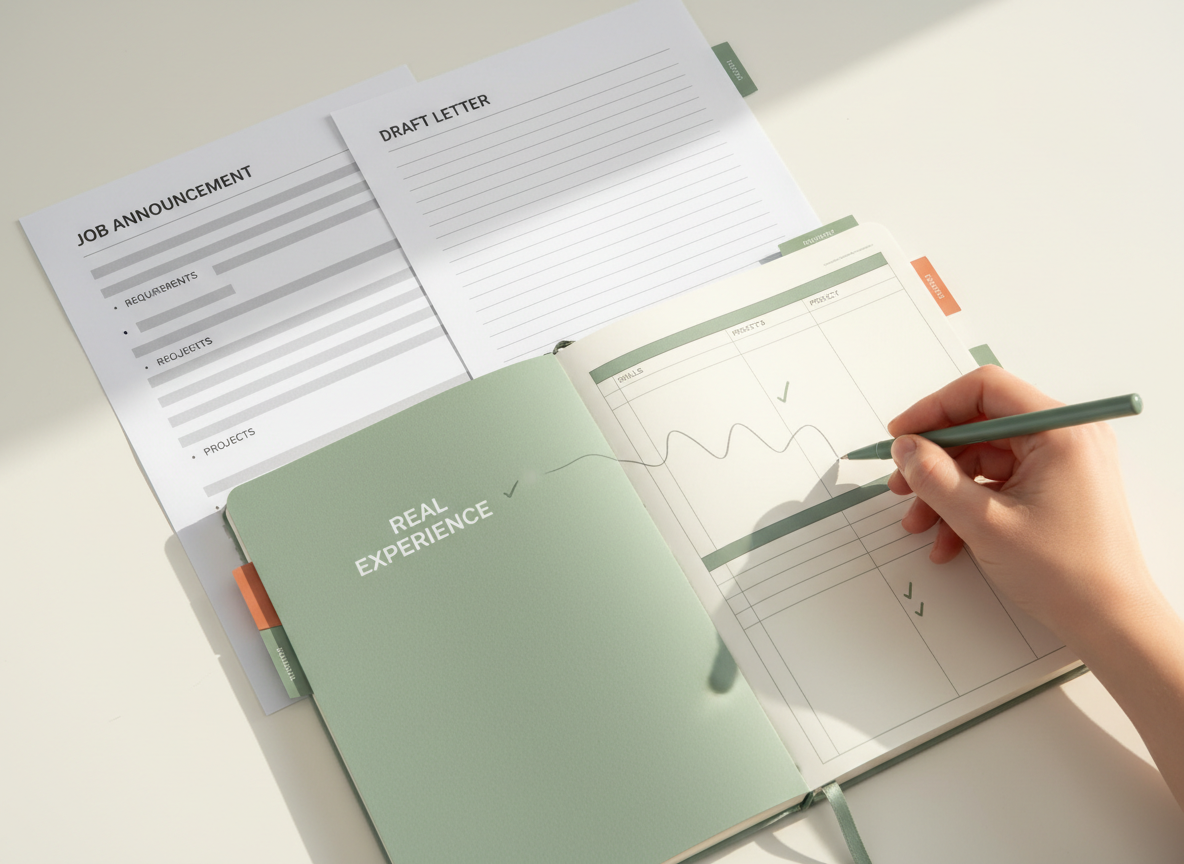
JOB REQUIREMENTS + VERIFIED EVIDENCE
Illustration: Map what the employer wants to work you can honestly describe.
Step 3: prepare non-sensitive information for AI drafting
You rarely need to share your complete unredacted résumé just to write a first draft. An official public job-posting excerpt, the exact job title, and a few verified skills and examples are usually sufficient. Do not paste your home address, government identification numbers, references, confidential client records, or unrelated personal details into a consumer AI service without first reviewing its policies and your employer’s rules.
If you do not know the recruiter’s name, don’t let AI manufacture one. If you do not know an employer’s current mission statement, do not pretend you researched it. Keep unknown details marked as unknown until you check the employer’s website or contact the organization.
Step 4: generate a concise first draft with a copy-ready prompt
CareerOneStop describes a short, tailored letter as a useful format, often roughly 200–400 words across three or four brief paragraphs. Use the actual employer’s directions if they differ. The prompt below asks for a draft you can review, not a document ready to submit automatically.
Act as a careful cover-letter editor, not a biographer.

TARGET JOB
Verified employer name: [organization]
Exact job title: [job title]
Public posting details: [2–3 important duties]
Why I am genuinely interested: [your reason]

VERIFIED BACKGROUND
My real experience #1: [specific action and context]
My real experience #2: [specific action and context]
Measured results: [verified metric or "not measured"]
Skills I have actually used: [list]
Unknown details: [list]

Draft a clear cover letter in about 200–300 words:
- Explain my interest in this specific role.
- Connect one or two TRUE experiences to the job.
- Use a warm, direct professional voice.
- Close courteously with interest in next steps.

Never invent jobs, promotions, certificates, dates,
achievements, metrics, employer facts or contact names.
Do not repeat the résumé verbatim.
Do not submit or send anything.
Add a short list of every fact I must verify.
When the first version sounds generic, supply a more concrete true example. Do not ask AI to make achievements ‘twice as impressive.’ A useful letter can be simpler than the AI’s first proposal, especially for an entry-level role.
Step 5: compare a weak opening with an honest one
Fictional example: applying for a program assistant role
Imagine a student volunteer who helped with a college event by maintaining a shared schedule and answering attendee questions. A public job posting for a program assistant emphasizes accurate schedule updates and communicating clear information. No real employer, interview, or AI outcome was tested for this example.
Weak and misleading opening: “I am a highly accomplished leader who revolutionized customer operations and delivered exceptional results.” The volunteer has no verified evidence for those claims.
Stronger truthful opening: “I am interested in the Program Assistant position because it involves organizing information and helping people receive clear, timely answers. While volunteering at a college event, I helped keep a shared schedule updated and directed attendees to confirmed information. I would welcome the opportunity to apply that careful approach to your team.”
The second version explains a contribution without manufacturing a management title, an employer reference, or a numerical improvement. The fictional applicant would still need to tailor the wording to the exact current posting.
Step 6: make AI check every claim, not just the grammar
Ask the assistant to find unsupported claims. Then independently compare its review against your real records and the official job advertisement. A smooth sentence is not proof of its truth.
Audit my draft against ONLY the verified evidence
and official job details I provide.

For each claim, create a table:
Claim | Supporting evidence | Keep / revise / remove

Check:
1. Employer name and precise job title
2. My role, work history, dates, and qualifications
3. Results, percentages, numbers, and certifications
4. Claims about the employer and its current priorities
5. Claims about teamwork, leadership, and responsibility
6. Unneeded personal or confidential details

Mark unsupported claims "NO EVIDENCE".
Do not create missing evidence.
Suggest a clear, shorter revision using supported facts.
Do not promise a hiring result or an ATS score.
If a claim cannot be verified, remove it or describe the genuine work more carefully. If an experience appears both in your résumé and the letter, the dates and responsibilities should agree. An AI tool should not quietly upgrade a supporting role into a leadership position.
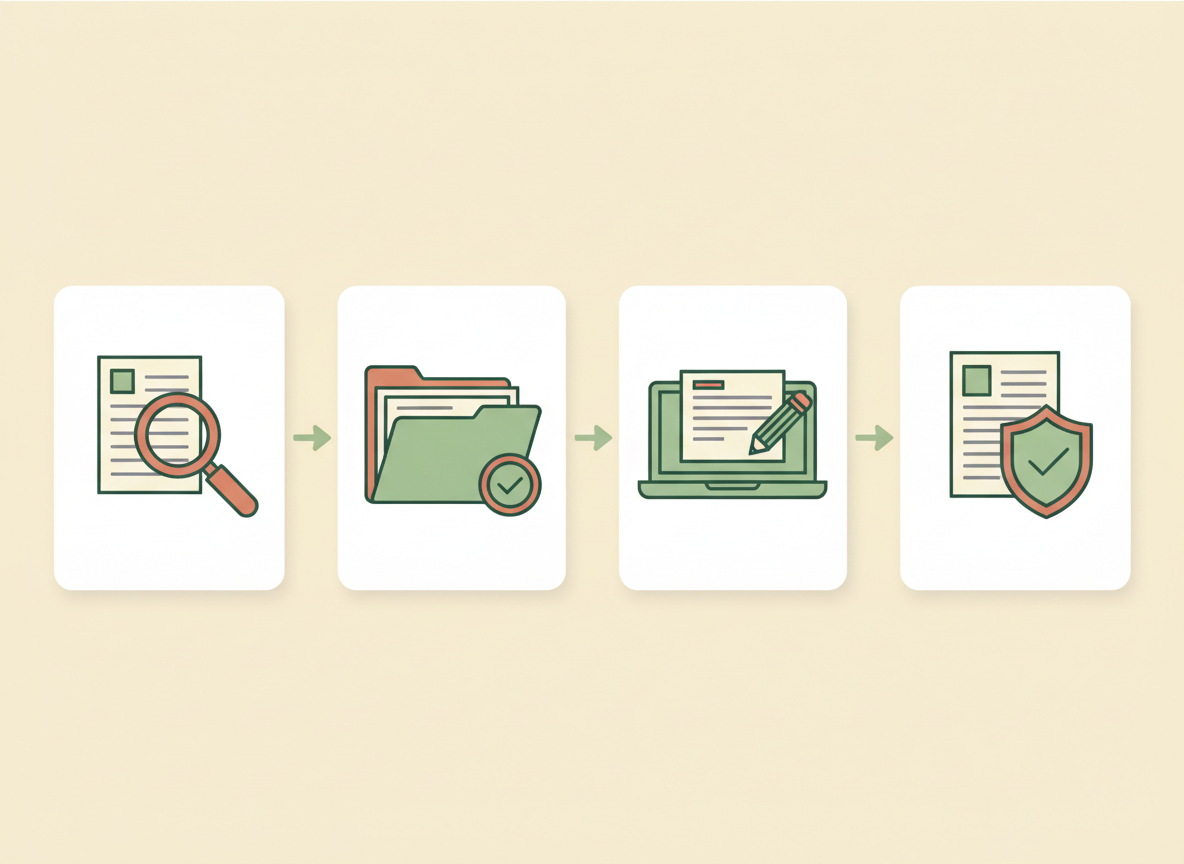
READ → MATCH → DRAFT → VERIFY
Illustration: Review the document yourself before it reaches an employer.
Step 7: proofread and submit the correct version
Check the recipient, employer, role, spelling, tone, required attachments, and file format. Remove generic placeholders or any accidental text copied from an AI instruction. If the job portal asks you to paste the letter into a field, preview the full pasted text. If the letter is attached, open the file you actually intend to submit. Never assume AI has submitted the document; complete the application yourself and retain the official confirmation.
- Read the latest vacancy instructions and make sure a letter is allowed or required.
- Confirm the correct organization, role, and contact details (when known).
- Match every personal claim to your own verified record.
- Check that dates, credentials, and results agree with your résumé.
- Remove private information and unsupported claims.
- Follow required format and character or page limits.
- Preview the uploaded or pasted document, submit through the official channel, and save confirmation.
A practical 20-minute cover-letter workflow
| Time | Action |
|---|---|
| 0–4 minutes | Read the posting and check whether the letter is required or optional. |
| 4–8 minutes | Write two verified experiences that match key job duties. |
| 8–13 minutes | Draft a focused letter with AI, keeping facts clearly bounded. |
| 13–17 minutes | Review the letter against your résumé and check the employer name. |
| 17–20 minutes | Proofread, check formatting and privacy, and prepare the final submission. |
This schedule is a hypothetical practice plan, not a tested productivity guarantee. More complex jobs and applications may need much longer verification, writing, or revision.
Federal applications: check USAJOBS instructions first
For U.S. federal jobs, cover letters are not universally required. USAJOBS document guidance says you may include a cover letter to share relevant skills or goals, while each announcement’s Required Documents section may contain both required and optional items. The official Required Documents guide explains how to identify what you must submit for that particular opening. An omission of truly required material can affect eligibility.
Do not copy a generic commercial cover-letter template into a specialized federal application without checking its specific questions, documentation, and requirements. When instructions are ambiguous, use the agency contact listed in the job announcement to clarify.
Common mistakes worth catching
- Mass-produced wording: A letter that could describe any role doesn’t explain why this one fits.
- Invented achievements: AI may add precise numbers or impressive credentials that you never supplied.
- Wrong organization: Reused templates can preserve the name or title from an earlier application.
- Fake employer research: Never claim you admire a current company project without checking it exists.
- Repeating the résumé: Explain the relevance of one or two accomplishments rather than copying every bullet.
- Over-sharing personal data: Draft from minimal authorized information and review AI privacy settings.
- Ignoring the application rules: A beautiful letter cannot replace required forms or mandatory documents.
Frequently asked questions
Do I always need a cover letter in the United States?
No. Requirements vary by employer and role. Read the current posting. When optional, use your judgment about whether it adds relevant information. When required, provide what the posting requests.
Can I use AI to write an entire cover letter?
It can generate a draft, but you should verify and personalize it. The final letter must accurately describe your experience and fit the specific employer. Treat AI as a writing assistant, not an independent source about your career.
How long should an AI-written cover letter be?
CareerOneStop suggests that a short cover letter can be about 200–400 words in three or four brief paragraphs. Use a different length if the actual application specifies one.
What if I have little or no paid experience?
Describe actual volunteer work, class projects, relevant courses, or transferable skills with accurate labels. A credible real example is more useful than fabricated professional history.
Can I reuse the same cover letter for different jobs?
You may reuse a structure, but verify and revise the job title, employer details, the most relevant experience, and reason for interest for every application. Do not automate submission without review.
Official sources and related career guides
- CareerOneStop: Cover letters — when to include one, suggested structure, and human review of AI assistance.
- USAJOBS: Application documents — cover letters and other application materials.
- USAJOBS: Required Documents section — interpreting mandatory and optional document listings.
- Improve your résumé with AI without inventing experience — get real evidence ready before you draft a letter.
- Practice a job interview with AI using truthful stories — prepare to discuss the same experience in your own words.
- Write professional work emails using AI — write a careful follow-up message.
Official references checked October 10, 2026. The student volunteer and program assistant job example are fictional and are not examples of an actual application or observed hiring result. Images are AI-generated illustrations. AI tool capabilities, privacy settings, employer rules, and federal document requirements can change; consult the official live posting before applying. This article is educational guidance, not an interview or employment guarantee.
Leave a Reply